
Warmer Summers Are Cutting Into Reindeer Grazing Time
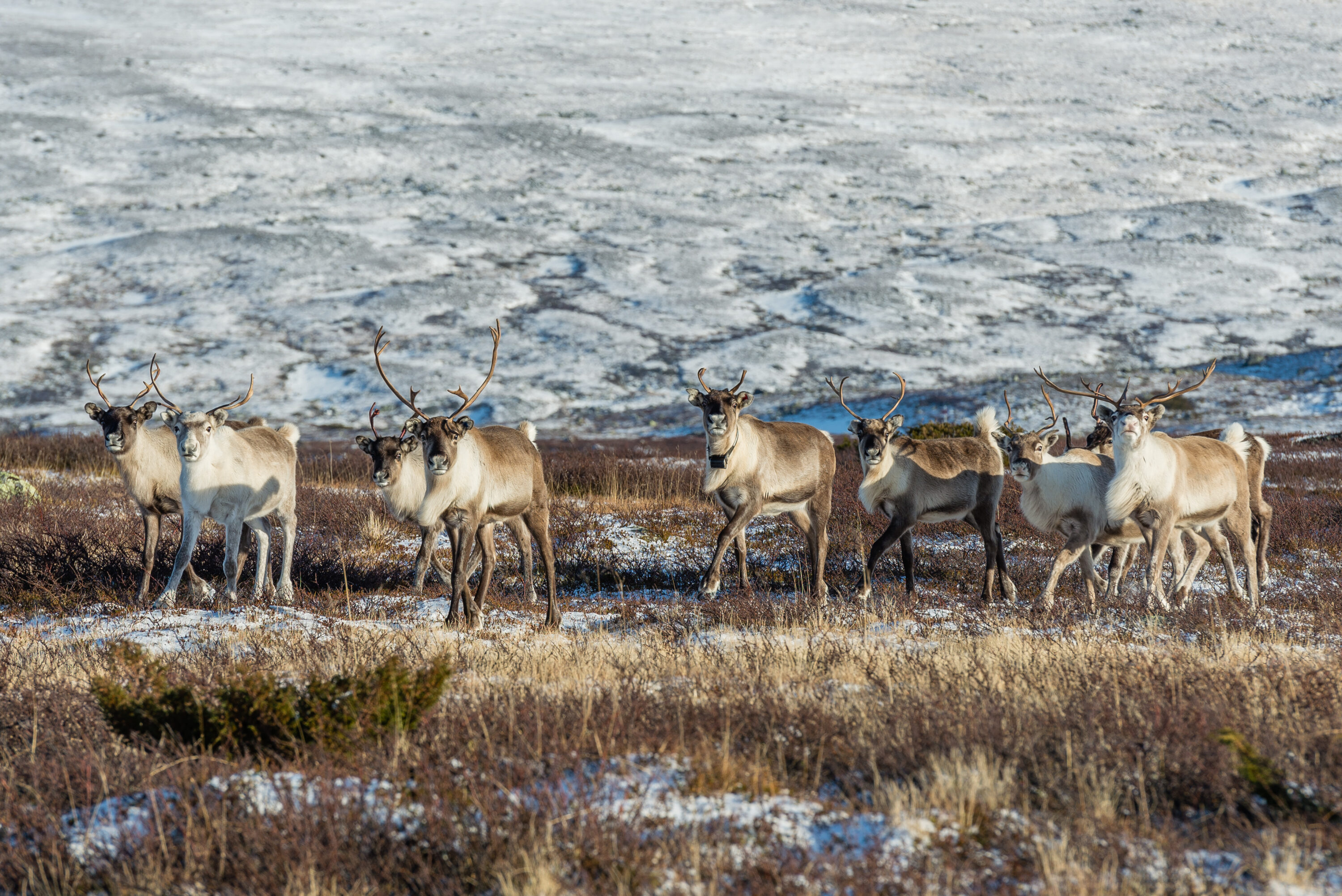
A 2026 study of free-ranging reindeer (Rangifer tarandus) in three Swedish herding districts shows how warm summer conditions can sharply reduce grazing and push the animals into less favourable parts of the mountain tundra.
An accelerometer measures body acceleration and movement over time; characteristic movement patterns can then be used to distinguish behaviours such as grazing and inactivity.
The researchers fitted 31 female reindeer with GPS collars, temperature sensors and tri-axial accelerometers during the summers of 2019 and 2020. These data allowed them to identify when the animals were grazing, how quickly they were moving and how their behaviour changed as body-surface and air temperatures rose.
Grazing declined above about 20.3°C body-surface temperature
Grazing began to decline once the measured body-surface temperature reached about 20.3°C. At a representative elevation of 952 m, the model linked this to an air temperature of about 11.0°C. At first the animals moved faster, a pattern the researchers interpret as consistent with increasing insect harassment. At still higher body-surface temperatures, above roughly 24°C — corresponding to about 15.9°C air temperature at the same elevation — movement speed fell sharply, which the authors interpret as evidence that physiological overheating was beginning to constrain activity. They caution that wind and precipitation can also affect thermoregulation, so the 24°C threshold should not be treated as an absolute physiological limit.
Warm conditions changed where grazing took place as well. Reindeer shifted grazing away from dry heath and other productive habitats towards high-elevation ground dominated by permanent snow and rocks. During warm spells, grazing around midday fell from roughly 50% of activity to below 35% and was replaced mainly by inactivity. The animals did not compensate at other times of day, leaving them with a little over one hour less grazing on a warm day.
Warm spells now occur during about half of the summer
The long-term weather record gives the behavioural result a wider context. Warm spells, defined in the study as days with a maximum air temperature of at least 13°C, became significantly more frequent between 1988 and 2022. They have exceeded half of summer days since about 2006–2008. Across the 35-year record, the long-term trend amounted to roughly eight additional warm days per summer.
Less grazing can affect more than the reindeer themselves. Reindeer are major herbivores in mountain tundra, where browsing and trampling can slow shrub expansion and help maintain open plant communities. If warming repeatedly suppresses grazing, it could therefore alter vegetation dynamics and contribute to further shrubification.
The study could not measure insect abundance directly, so the relative roles of insects and heat stress remain partly inferred from the animals’ movement patterns.
Ecology
Related news

Inland Mute Swans Had Higher Winter Body Condition Despite Harsher Winters and Supplemental Feeding
A study of 853 mute swans from four Polish wintering regions found higher body condition inland than on…
Read story →
Gut Microbiomes Across Nine Kruger Mammals Clustered More Strongly by Dietary Group Than Species
A study of 89 quality-filtered faecal samples from nine wild mammals in Kruger National Park found that carnivores,…
Read story →
Dunnock Spring Passage Advanced by Up to 8.3 Days Over 61 Years at Hel
Standardised ringing data from northern Poland showed that the first, median and last phases of dunnock spring passage…
Read story →SPECIES IN THIS STORY
Species in this story
Independent research and conservation news archive
Did you find this information useful?
Wildlife Vagabond is independently built and maintained. Voluntary support helps cover source verification, hosting and continued work on research and conservation news.
Support Wildlife VagabondThe news archive will remain freely available.