
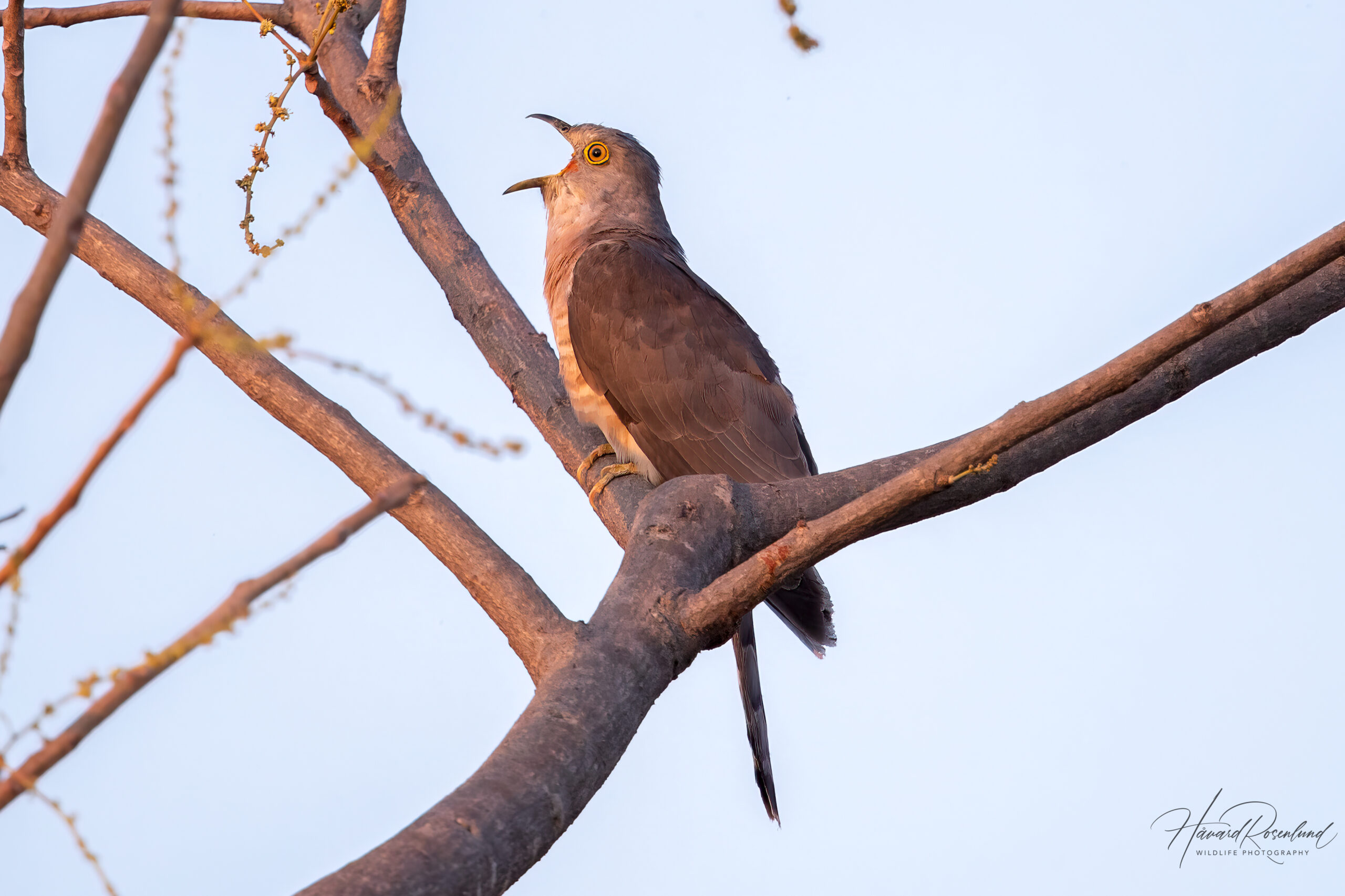
Common Hawk-Cuckoo
Hierococcyx varius
At a glance
Habitat
- Deciduous and secondary woodland, plantations, groves, gardens and other wooded human-modified habitats
Diet
- Mostly insects, especially caterpillars, including hairy caterpillars
Activity
- Diurnal, though males may call well into the night during breeding
Size
- Length: about 33 cm Weight: about 104 g
Range
- Indian subcontinent east to Myanmar, including Sri Lanka
Description
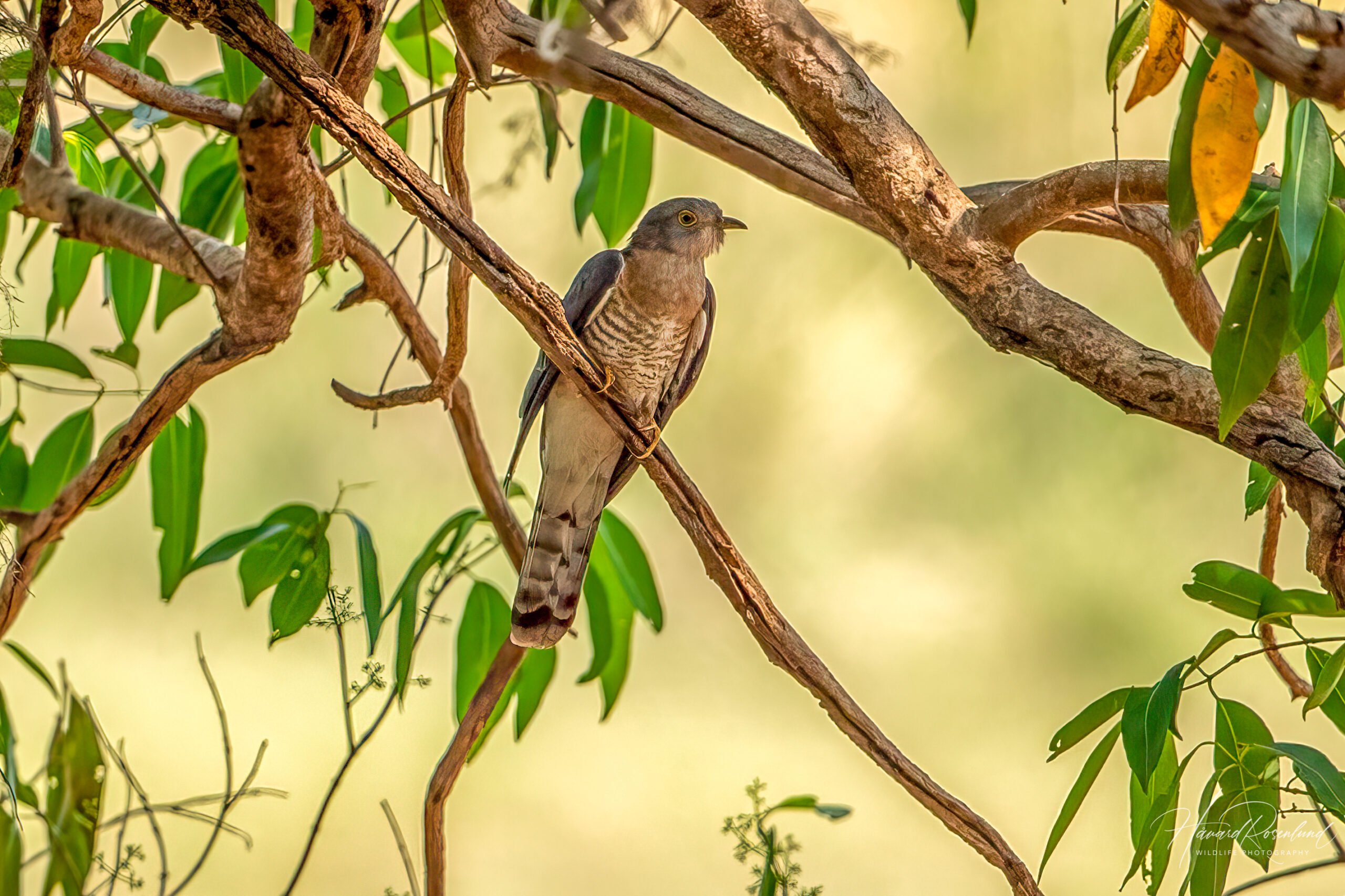
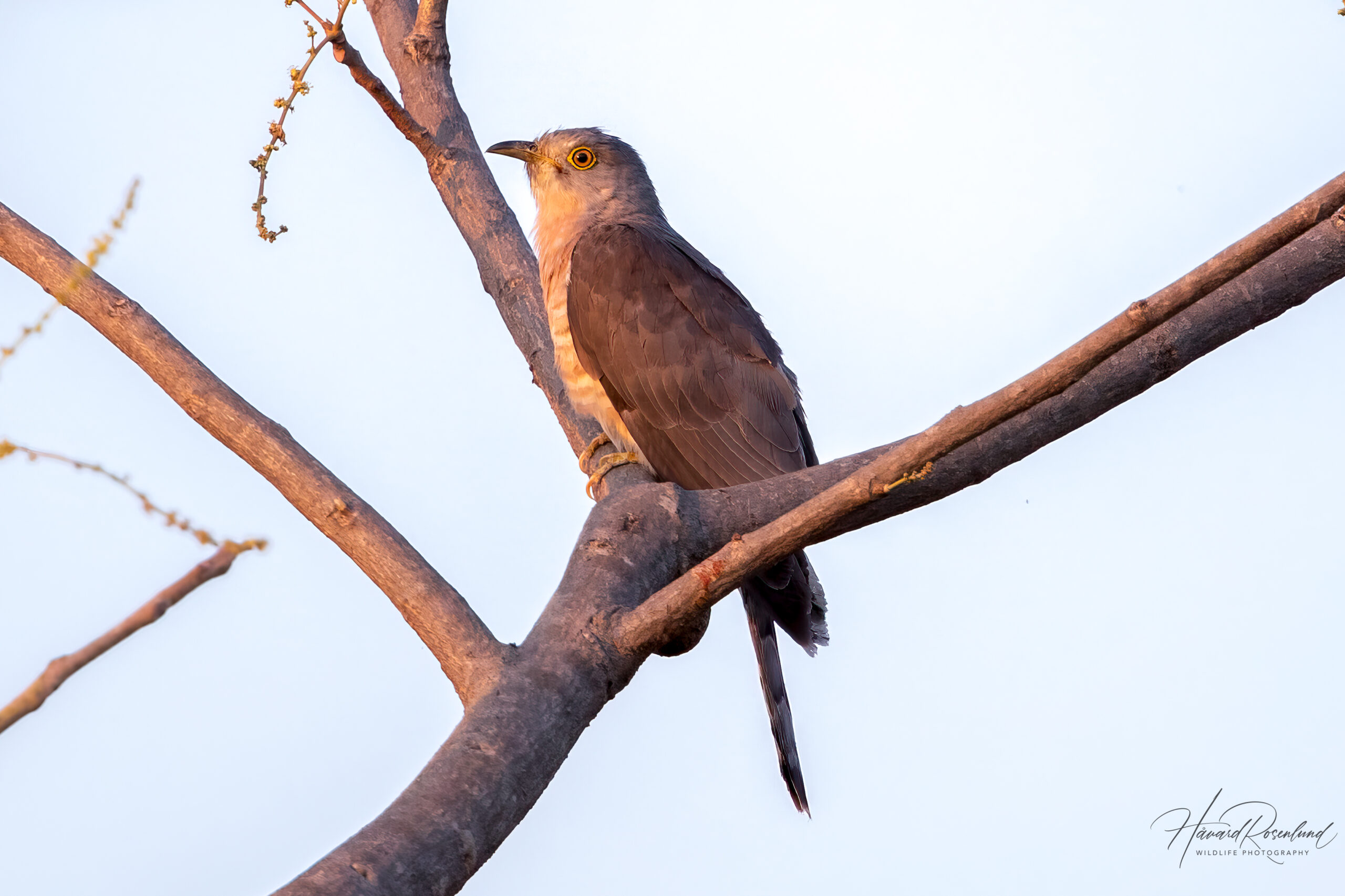
The common hawk-cuckoo (Hierococcyx varius) is a medium-sized cuckoo of the Indian subcontinent and neighbouring Myanmar. Adults are about 33 cm long and weigh roughly 104 g. They are grey above and pale below with strong brown barring, a long barred tail and a conspicuous yellow eye-ring. The combination of shape, barred underparts and flight can make the bird look remarkably like a small shikra (Tachyspiza badia), the resemblance that gives the species its English name.
Habitat
Common hawk-cuckoos inhabit deciduous and secondary woodland, forest edges, plantations, groves and well-wooded gardens. They readily occur close to settlements where mature trees and dense foliage remain, and are usually found in the canopy or middle levels rather than on the ground.
The species is therefore able to use quite heavily modified landscapes, but remains dependent on sufficient tree cover and on the presence of suitable host birds for breeding.
Diet
The diet is dominated by insects, especially caterpillars. Common hawk-cuckoos are particularly notable for taking hairy caterpillars that many other insect-eating birds avoid. Grasshoppers, locusts and other arthropods are also eaten, while fruit and small vertebrates appear to be occasional additions.
Most food is taken from foliage and branches, with the bird moving quietly through the canopy while searching for prey.
Vocalisations
The common hawk-cuckoo is especially well known for the male's loud three-note breeding call. The phrase rises in pitch and intensity as it is repeated, which has given the species the English nickname “brain-fever bird”. Calling can continue for long periods and may carry on after dark, making the voice one of the easiest ways to detect the species even when the bird remains hidden in foliage.
The video below shows a calling male near Kanha National Park, India, on 8 April 2023.
Breeding
Common hawk-cuckoos are obligate brood parasites and do not build nests or raise their own young. Babblers are their principal hosts, with the jungle babbler (Argya striata) especially important across much of the range. The female lays an egg in the host nest and leaves incubation and chick-rearing to the foster parents.
A study published in 2016 at Jahangirnagar University in Bangladesh found very close matching in colour, pattern and size between common hawk-cuckoo eggs and those of jungle babblers. Five of eleven monitored babbler nests were parasitised by common hawk-cuckoos. After hatching, the cuckoo chick can remove host eggs or young from the nest, leaving the foster parents to concentrate their care on the cuckoo chick.
The species also uses other babblers as hosts in parts of its range. A study published in 2001 at Kerala Agricultural University in Thrissur, southern India, found that exposed nests of yellow-billed babblers (Argya affinis) were especially likely to be parasitised. Breeding timing is therefore closely linked to the nesting cycle of local host populations.
Status
The common hawk-cuckoo is classified as least concern on the IUCN Red List. It remains widespread across the Indian subcontinent and uses both natural woodland and wooded human-modified habitats.
State of India's Birds lists the species as a low conservation priority. Its 2025 update shows that the long-term national trend remains uncertain, while the more recent annual trend is clearly positive.
Image gallery
Loading map and observations…
Have you seen this species?
Independent species archive
Did you find this species page useful?
Wildlife Vagabond is independently built and maintained. Voluntary support helps cover hosting, maps, data storage and continued improvements to the species archive.
Support Wildlife VagabondSpecies content will remain freely available.
References
Information about the species’ global distribution and status is based primarily on global Red List data. See the references below for details.
- BirdLife International. (n.d.). Common Hawk-Cuckoo species factsheet. https://datazone.birdlife.org/species/factsheet/common-hawk-cuckoo-hierococcyx-varius
- eBird. (n.d.). Common Hawk-Cuckoo. Cornell Lab of Ornithology. https://ebird.org/species/cohcuc1
- International Union for Conservation of Nature. (n.d.). Common Hawk-Cuckoo. The IUCN Red List of Threatened Species. https://www.iucnredlist.org/species/22683846/93003793
- Nahid, Begum & Feeroz. (2016). Brood parasitic cuckoos and their hosts in Jahangirnagar University campus. Indian BIRDS, 12, 64–69. https://indianbirds.in/pdfs/IB_12_2_3_NahidETAL_Cuckoos.pdf
- Prasad, G., Nameer, P., & Reshmi, M. (2001). Brood parasitism by Common Hawk-Cuckoo (Hierococcyx varius Vahl.). Zoos' Print Journal, 16(8), 554-556. https://doi.org/10.11609/JoTT.ZPJ.16.8.554-6
- Praveen & Lowther. (2020). Avian brood parasitism in South Asia. Indian BIRDS, 16, 103–119. https://indianbirds.in/pdfs/IB_16_4_Praveen_Lowther_AvianBroodParasitism_Video.pdf
- State of India's Birds. (2025). 2025 – Common Hawk Cuckoo. https://stateofindiasbirds.in/species/cohcuc1/
- Tobias, J. A., Sheard, C., Pigot, A. L., Devenish, A. J. M., Yang, J., Sayol, F., Neate‐Clegg, M. H. C., Alioravainen, N., Weeks, T. L., Barber, R. A., Walkden, P. A., MacGregor, H. E. A., Jones, S. E. I., Vincent, C., Phillips, A. G., Marples, N. M., Montaño‐Centellas, F. A., Leandro‐Silva, V., Claramunt, S., … Schleuning, M. (2022). AVONET: morphological, ecological and geographical data for all birds. Ecology Letters, 25(3), 581-597. https://doi.org/10.1111/ele.13898