
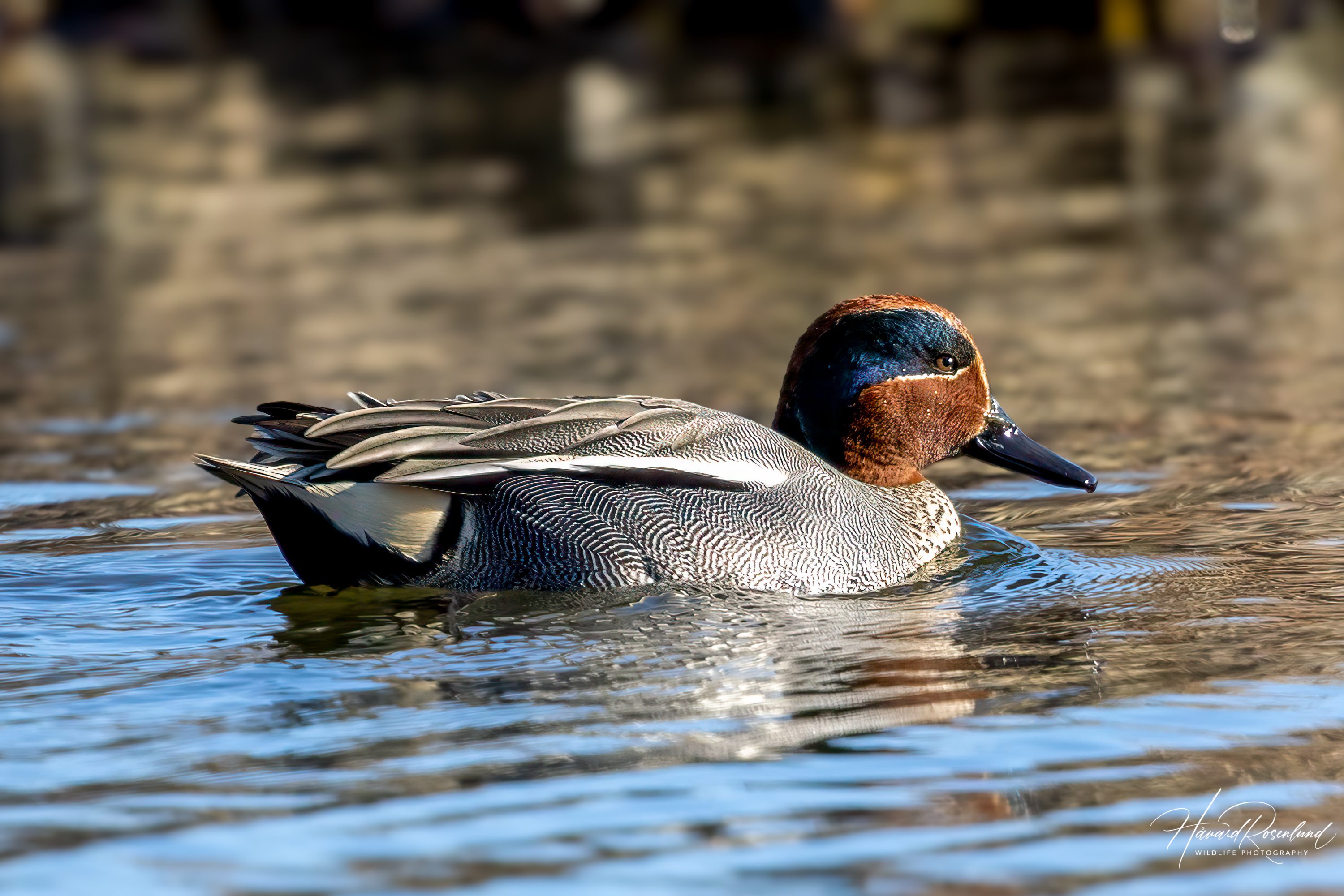
Green-winged Teal
Anas crecca
At a glance
Habitat
- Shallow, well-vegetated freshwater wetlands when breeding; also estuaries, lagoons, mudflats and flooded fields outside the breeding season.
Diet
- Seeds and other plant material, together with aquatic insects, molluscs and small crustaceans; proportions vary with season.
Activity
- Often feeds from dusk through the night in winter, but can also forage by day.
Size
- Length: 34–38 cm Weight: 200–360 g
Range
- Breeds across northern Eurasia and North America and winters farther south across Europe, Africa, Asia and the Americas.
Description
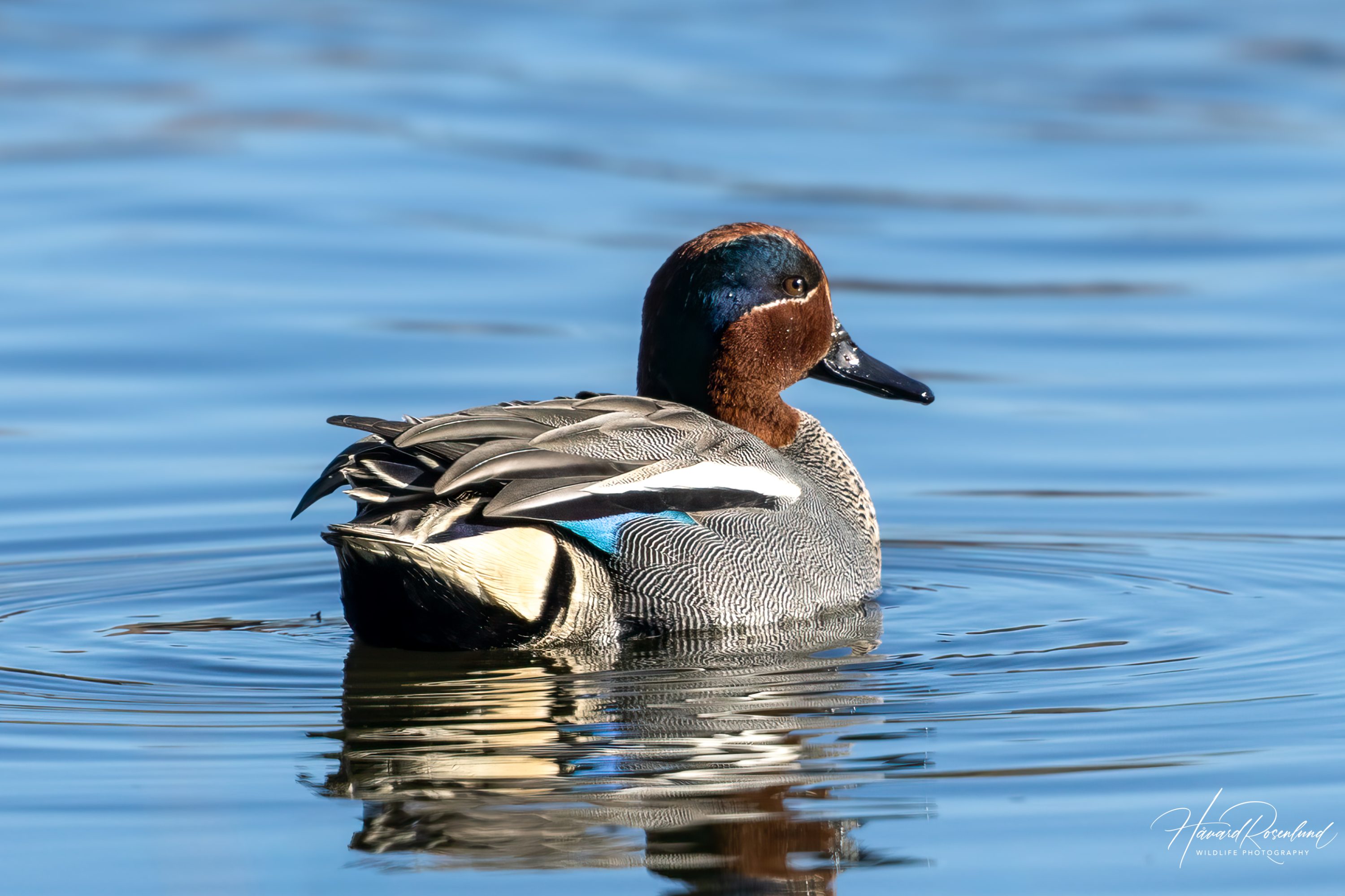
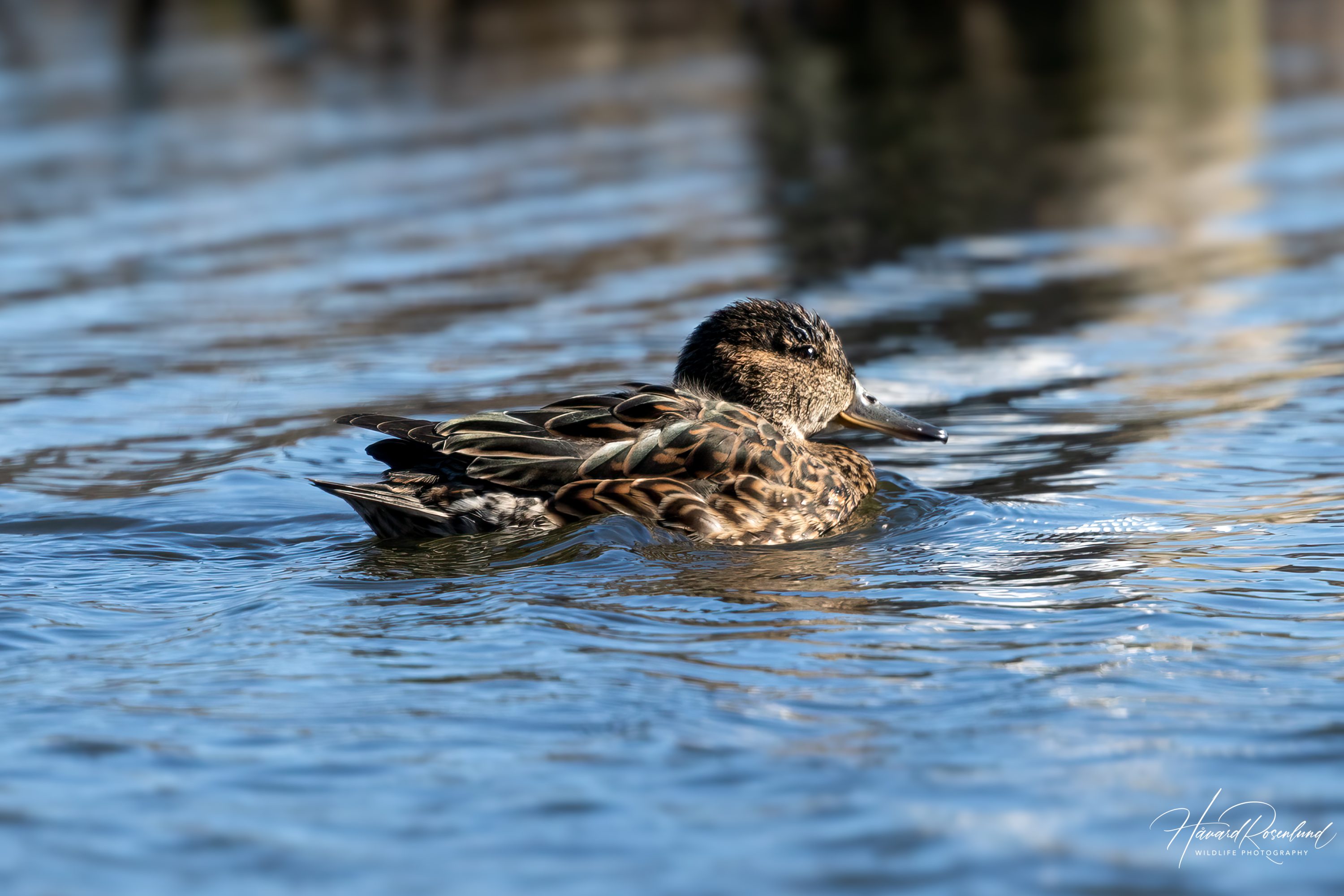
The green-winged teal (Anas crecca) is one of the smallest dabbling ducks in the world. It has a compact body, short neck and narrow, pointed wings that give it a fast and agile flight. Breeding males have a chestnut head with a broad metallic-green patch around the eye, a finely patterned grey body and a green wing patch, or speculum. Females are mottled brown and much less conspicuous.
Adults are about 34–38 cm long and typically weigh about 200–360 g. In flight, both sexes show the green speculum and move with quick wingbeats, often in tightly coordinated flocks.
Taxonomy
The taxonomy of the green-winged teal has changed repeatedly. The Eurasian form Anas crecca crecca and the North American form A. c. carolinensis were long treated as separate species by several authorities. A population-genomics study published in 2023 also examined the sedentary Aleutian form A. c. nimia. Genome-wide nuclear DNA grouped the three northern forms together, while mitochondrial DNA produced a different evolutionary tree; demographic analyses found continued gene flow among the lineages. AviList reunited the Eurasian and North American forms under a single species, Anas crecca, in 2025.
Males are readily separable in breeding plumage: carolinensis normally has a vertical white bar on the side of the breast, while the nominate Eurasian form lacks this and instead shows a more horizontal pale line along the scapulars.
Habitat
During the breeding season, green-winged teal favour shallow freshwater habitats with abundant cover, including ponds, marshes, bogs, tundra wetlands and small forest pools. Outside the breeding season they use a much broader range of wetlands, including estuaries, coastal lagoons, mudflats and flooded agricultural land.
The species often rests in sheltered wetlands by day and moves to shallow feeding areas around dusk, although local patterns vary with food availability, disturbance and local conditions.
Diet
The diet combines plant and animal food and changes with season and habitat. Seeds and other plant material are especially important outside the breeding season, while aquatic insects, molluscs and small crustaceans become more important during spring and summer and provide protein for growing ducklings.
Green-winged teal feed in very shallow water and on exposed mud, picking food from the surface or tipping forward to reach food below the water. Fine comb-like structures called lamellae line the edges of the bill and filter small food particles from the water. Their small size allows them to exploit very shallow feeding sites that larger dabbling ducks may use less efficiently.
Behaviour
Outside the breeding season, green-winged teal are highly social and may gather in flocks numbering hundreds or thousands. Flocks are exceptionally agile in flight, twisting and changing direction in close formation when disturbed.
Wintering teal often show a strong day–night rhythm, resting communally during daylight and dispersing to feed from dusk into the night. This pattern is flexible, however, and birds may feed extensively by day where suitable food and undisturbed habitat are available.
Males give a distinctive high whistle, while females give quacking calls. Vocalisations are especially common during courtship and when the birds are in groups.
Migration
Most northern populations are strongly migratory. Eurasian birds move from breeding areas across northern Europe and Asia to wintering grounds farther south in Europe, Africa and Asia, while North American birds migrate south into the United States, Mexico and the Caribbean.
A satellite-tracking study published in 2019 followed 29 Eurasian teal wintering at three sites in Italy. Because many birds stopped for several weeks, particularly early in migration, overall progress during spring migration averaged about 36 km per day, while active travel reached as much as 872 km in a day.
A study published in 2023 analysed 30 tracked Eurasian teal from Italian wintering areas. The birds tended to continue from stopover sites as spring advanced along the route, especially when soil temperatures had risen, cloud cover was low and winds favoured northward travel.
Breeding
Pairs usually form before or during spring migration. The female selects a concealed nest site on the ground, typically among grasses, sedges or other dense vegetation near freshwater. She alone incubates the eggs and later leads the brood.
Clutch size varies between populations. Eurasian teal commonly lay about 8–11 eggs, with 7–15 recorded, while North American carolinensis typically lays around 6–9. Incubation lasts about 20–23 days. The precocial ducklings leave the nest soon after hatching and can swim and feed for themselves, but remain under the female’s protection. Eurasian young commonly become capable of flight after about 25–30 days, while North American carolinensis generally do so at around 34–35 days.
Most birds can breed at one year old. The North American longevity record is at least 20 years and 3 months, while BTO ringing records for Eurasian teal include a bird of more than 18 years.
Status
IUCN’s available assessment of Anas crecca was published in 2020, when BirdLife treated the North American carolinensis as a separate species. It lists the Eurasian Anas crecca as least concern. AviList reunited the Eurasian and North American forms in 2025, so the current IUCN assessment does not correspond exactly to the broader species presented on this page. Across the combined range, wetland loss and degradation, pollution and hunting can affect populations locally.
Image gallery
Loading map and observations…
Have you seen this species?
Independent species archive
Did you find this species page useful?
Wildlife Vagabond is independently built and maintained. Voluntary support helps cover hosting, maps, data storage and continued improvements to the species archive.
Support Wildlife VagabondSpecies content will remain freely available.
References
Information about the species’ global distribution and status is based primarily on global Red List data. See the references below for details.
- Artsdatabanken. (2021). Krikkand, Norsk rødliste 2021. https://lister.artsdatabanken.no/rodlisteforarter/2021/14148
- AviList. (n.d.). Green-winged Teal (Anas crecca). https://explore.avilist.org/
- BirdLife International. (n.d.). AviList unites the world’s bird species (2025). https://www.birdlife.org/news/2025/06/11/avilist-unites-the-worlds-bird-species/
- BirdLife Norge. (n.d.). følger AviList (2025). https://www.birdlife.no/organisasjonen/nyheter/?id=3793
- British Trust for Ornithology. (n.d.). Teal birdfacts. https://www.bto.org/learn/about-birds/birdfacts/teal
- Cerritelli, G., Vanni, L., Baldaccini, N. E., Lenzoni, A., Sorrenti, M., & Giunchi, D. (2023). Trailing the heat: Eurasian teal Anas crecca schedule their spring migration basing on the increase in soil temperatures along the route. Journal of Avian Biology, 2023(9-10), e03122. https://doi.org/10.1111/jav.03122
- Cornell Lab of Ornithology. (n.d.). Green-winged Teal, All About Birds. https://www.allaboutbirds.org/guide/Green-winged_Teal/overview
- Giunchi, D., Baldaccini, N. E., Lenzoni, A., Luschi, P., Sorrenti, M., Cerritelli, G., & Vanni, L. (2019). Spring migratory routes and stopover duration of satellite‐tracked Eurasian Teals Anas crecca wintering in Italy. Ibis, 161(1), 117-130. https://doi.org/10.1111/ibi.12602
- International Union for Conservation of Nature. (n.d.). Anas crecca (2020 assessment). The IUCN Red List of Threatened Species. https://www.iucnredlist.org/species/22680321/181692388
- Spaulding, F., McLaughlin, J. F., Cheek, R. G., McCracken, K. G., Glenn, T. C., & Winker, K. (2023). Population genomics indicate three different modes of divergence and speciation with gene flow in the green-winged teal duck complex. Molecular Phylogenetics and Evolution, 182, 107733. https://doi.org/10.1016/j.ympev.2023.107733
- Tamisier, A. (1970). Signification du grégarisme diurne et de l'alimentation nocturne des Sarcelles d’hiver Anas crecca crecca L. La Terre et La Vie, Revue d'Histoire naturelle, 24(4), 511-562. https://doi.org/10.3406/revec.1970.4813