
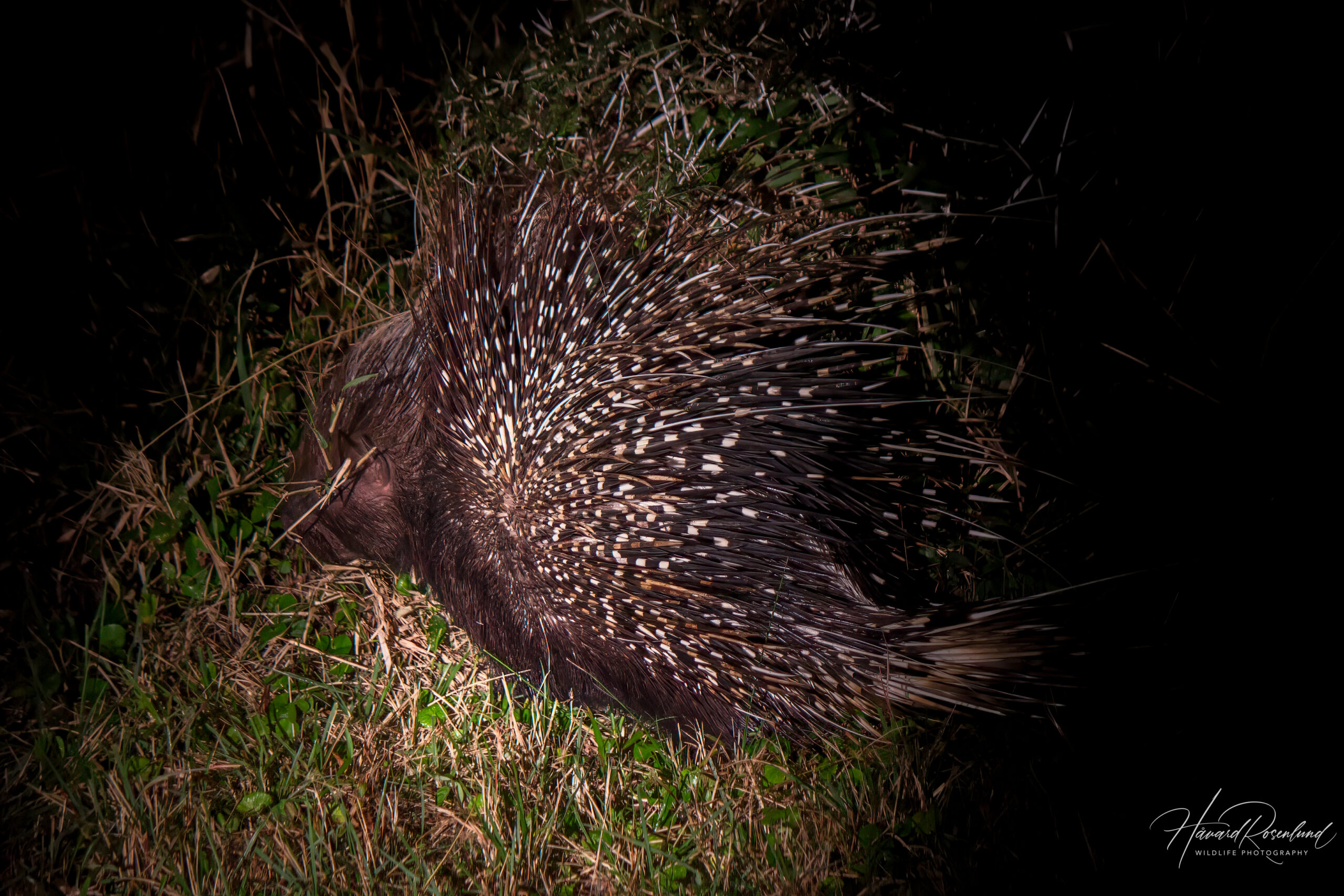
Cape Porcupine
Hystrix africaeaustralis
At a glance
Habitat
- Grassland, savanna, shrubland, open woodland and farmland; avoids extreme deserts and dense forest
Diet
- Herbivore: roots, bulbs, tubers, bark, leaves and fruit; also gnaws bones
Activity
- Nocturnal
Size
- Length: 63–81 cm Weight: 10–24 kg
Range
- From the Congo region and East Africa south through much of southern Africa
Description
The Cape porcupine, or South African porcupine (Hystrix africaeaustralis), is one of the world’s largest living porcupines and the largest native rodent in southern Africa. Head-and-body length is about 63–81 cm, the tail adds roughly 11–20 cm and adults commonly weigh 10–24 kg, although exceptionally large animals can approach 30 kg.
Long black-and-white quills and shorter defensive spines cover the back and flanks, while a crest of coarse hair runs from the head to the shoulders. Cape porcupines cannot shoot their quills. Instead, the quills detach readily on contact and can become embedded in an attacker.
The similar crested porcupine (Hystrix cristata) overlaps with the Cape porcupine in parts of East Africa, so geography alone is not enough for identification. Short quills on the lower rump are white in the Cape porcupine but dark in the crested porcupine, although the two can still be difficult to distinguish in the field.
Habitat
Cape porcupines occupy a very wide range of habitats, including grassland, savanna, shrubland, open woodland, semi-arid country and agricultural landscapes, from sea level to about 2,000 m. They avoid swampy ground, the most extreme deserts and the densest forest.
During the day they shelter in rock crevices, caves, termite mounds or burrows. They may excavate their own dens or enlarge abandoned aardvark (Orycteropus afer) burrows. A family may irregularly use as many as six different burrows, and the main tunnels of large systems can extend around 20 m.
Diet
The diet is overwhelmingly plant-based and includes roots, bulbs, tubers, rhizomes (underground stems), bark, leaves, shoots, stems and fallen fruit. Cape porcupines dig extensively for underground plant parts and may also uproot young trees or strip bark. In farmland the same feeding behaviour brings them to potatoes, maize, melons, pumpkins and other cultivated crops.
They also carry and gnaw bones. This is especially common where phosphorus is scarce and may provide extra minerals while helping wear the continuously growing incisors. Carrion has occasionally been reported, but it is not an important part of the normal diet.
The digging itself also affects the surrounding environment. Foraging pits disturb the soil, create places where water can soak in more easily and open small patches where seedlings can establish. Cape porcupines can therefore alter local conditions in ways that also affect other species.
Behaviour
Cape porcupines are nocturnal and spend most of the active period travelling and feeding on the ground. They normally forage alone, although paired animals often remain surprisingly close to one another. Activity can decrease on bright moonlit nights, when the animals make greater use of dense cover before returning to familiar shelters by day.
When threatened, a porcupine raises its crest and quills, stamps, hisses and rattles the hollow quills on its tail. If these warnings fail, it can rush backwards or sideways with the heavily armed rump towards the threat, or retreat into a burrow with the quills facing the entrance.
Social behaviour
Unlike many rodents, Cape porcupines usually live in stable, monogamous pairs. The family group is built around one adult male–female pair and may also include immature offspring from successive litters. When opportunities to leave are limited, mature offspring can remain with the family for longer, and unusually large groups have occasionally shared the same burrow.
Both parents care for the young. Adult males may accompany juveniles on feeding trips and help defend them, while parents and offspring often huddle together in the burrow. This social contact is especially important for small young during their first weeks.
Home ranges
Members of a pair share strongly overlapping home ranges, while a smaller area used most intensively is largely exclusive and defended from neighbouring families. Scent marking appears important in this defence: both sexes mark the area, but males do so more frequently than females. Older tracking studies found that animals feeding on natural foods used larger areas in winter than in summer, while crop-feeding animals moved differently because food was more concentrated.
A later tracking study in farmland, suburban and urban-edge areas of KwaZulu-Natal estimated an average home range of about 39 ha, with individual ranges of roughly 13–67 ha. Animals on farmland used the smallest ranges on average, while suburban animals used larger ones. The contrast shows how strongly food distribution and human land use can change the amount of space needed by the same species.
Predation
Leopards (Panthera pardus) and lions (Panthera leo) are the main natural predators documented for Cape porcupines. The quill defence makes them unusually dangerous prey, however, and probably prevents many attacks from succeeding. Humans are thought to cause more Cape porcupine deaths overall than natural predators.
Lions still take porcupines, particularly in some dry ecosystems, but an attack can carry a serious cost. Reviews of African lion–porcupine encounters document quills penetrating the face, limbs and body, sometimes producing severe wounds, infection or difficulty hunting and feeding. In exceptional cases these injuries have contributed to the lion’s death. The porcupine’s defensive display is therefore more than a warning: it can make an attack dangerous even for one of Africa’s largest carnivores.
Reproduction
Cape porcupines can reproduce throughout the year, but in summer-rainfall regions most births occur during the warmer wet season. Females return to oestrus—a period when they are receptive to mating—repeatedly if they do not become pregnant, and oestrus lasts on average about nine days. Gestation lasts about 93–94 days in well-studied captive animals.
Litters contain one to three young, and singletons are the most common. The young are born well developed, weighing roughly 300–400 g, with open eyes and soft defensive quills that soon harden. They begin nibbling solid food within the first two weeks but remain in the burrow for about nine weeks and continue nursing for roughly three to four months.
Males may become sexually mature from around 8–18 months, while females generally mature during the second year. Even after maturity, daughters that remain with the family normally do not conceive; they usually need to leave the family group before breeding successfully. Wild individuals can live for around a decade, while captive animals may exceed 20 years.
Cultural significance
Porcupines and their formidable quills have acquired symbolic and medicinal significance in parts of southern Africa. SANBI notes beliefs that porcupines possess protective powers, and traditional preparations have used parts of the animal in remedies associated with strength and protection.
Quills also have specific uses. In some Zulu medicinal practice they may be used when making small skin incisions for the application of topical remedies. Such traditions vary between communities, but they show that the porcupine’s distinctive armour has shaped its cultural importance as well as its biology.
Relationship with humans
Cape porcupines adapt readily to farmland and other human-modified landscapes, but their digging and bark feeding can make them serious agricultural pests. They may damage vegetable crops, maize, fruit and young trees, and in some areas they are actively persecuted by farmers and farm workers.
The species is also hunted for meat and its quills are collected for ornaments, jewellery and décor. These uses are not severe enough to threaten the species across its range, but heavy hunting and persecution can remove local populations. Wildlife-friendly fence passages and other measures that allow porcupines to move through agricultural landscapes without breaking fences can reduce conflict while keeping habitats connected.
Status
The Cape porcupine is listed as Least Concern on the IUCN Red List. It remains widespread from parts of central and eastern Africa south through much of southern Africa, and the overall population trend is considered stable.
Its broad habitat tolerance and ability to persist in modified landscapes make the species highly adaptable. Local declines and even local disappearances can nevertheless occur where hunting and persecution are intense, so the global category should not be read as an absence of regional pressure.
Image gallery
Loading map and observations…
Have you seen this species?
Independent species archive
Did you find this species page useful?
Wildlife Vagabond is independently built and maintained. Voluntary support helps cover hosting, maps, data storage and continued improvements to the species archive.
Support Wildlife VagabondSpecies content will remain freely available.
References
Information about the species’ global distribution and status is based primarily on global Red List data. See the references below for details.
- Barthelmess, E. L. (2006). Hystrix africaeaustralis. Mammalian Species, 788, 1-7. https://doi.org/10.1644/788.1
- Corbet, N. U., & van Aarde, R. J. (1996). Social organization and space use in the Cape porcupine in a Southern African savanna. African Journal of Ecology, 34(1), 1-14. https://doi.org/10.1111/j.1365-2028.1996.tb00589.x
- International Union for Conservation of Nature. (n.d.). Hystrix africaeaustralis (Cape Porcupine). The IUCN Red List of Threatened Species. https://www.iucnredlist.org/species/10748/115099085
- Mammal Diversity Database. (2026). Hystrix africaeaustralis: current taxonomy and distribution. American Society of Mammalogists. https://www.mammaldiversity.org/taxon/1001283/
- Peterhans, J. C. K., Celesia, G. G., & Gnoske, T. P. (2019). Lion-Porcupine Interactions in Africa, Including Impacts on Lion Predatory Behavior. Journal of East African Natural History, 108(1), 1. https://doi.org/10.2982/028.108.0101
- South African National Biodiversity Institute. (n.d.). Cape porcupine: biology, habitat, people and conservation. https://www.sanbi.org/animal-of-the-week/cape-porcupine/
- South African National Biodiversity Institute. (n.d.). Hystrix africaeaustralis regional assessment. https://speciesstatus.sanbi.org/assessment/last-assessment/02078/
- van Aarde, R. J., & Skinner, J. D. (1986). Reproductive biology of the male Cape porcupine, Hystrix africaeaustralis. Reproduction, 76(2), 545-552. https://doi.org/10.1530/jrf.0.0760545
- van Aarde, R. J. (1985). Reproduction in captive female Cape porcupines (Hystrix africaeaustralis). Reproduction, 75(2), 577-582. https://doi.org/10.1530/jrf.0.0750577
- Wilson, D. E., Lacher, T. E., Jr., & Mittermeier, R. A. (2016). Hystrix africaeaustralis Peters 1852. In Handbook of the Mammals of the World – Volume 6: Lagomorphs and Rodents I (pp. 310–311). Lynx Edicions. https://doi.org/10.5281/zenodo.6615334