
Common Kestrel Pellets Had Much Higher Microplastic Concentrations Than Barn Owl Pellets in Hampshire

A study of regurgitated pellets from common kestrels (Falco tinnunculus) and barn owls (Tyto alba) in Hampshire, England, found microplastics in most samples from both species, but at markedly different concentrations. Researchers collected 24 pellets from each species at paired nest sites in August 2024 and identified particles using Fourier-transform infrared spectroscopy (FTIR), which distinguishes plastic polymers from their characteristic absorption of infrared light.
Microplastics were detected in 22 of 24 kestrel pellets, or 92%, and 20 of 24 barn owl pellets, or 83%. Median density was significantly higher in kestrel pellets at 18.46 particles per gram of dry pellet, compared with 0.42 particles per gram in barn owl pellets. Thirteen polymer types were identified across the samples, and the most numerous particles in both species were in the 25–50 μm size class.
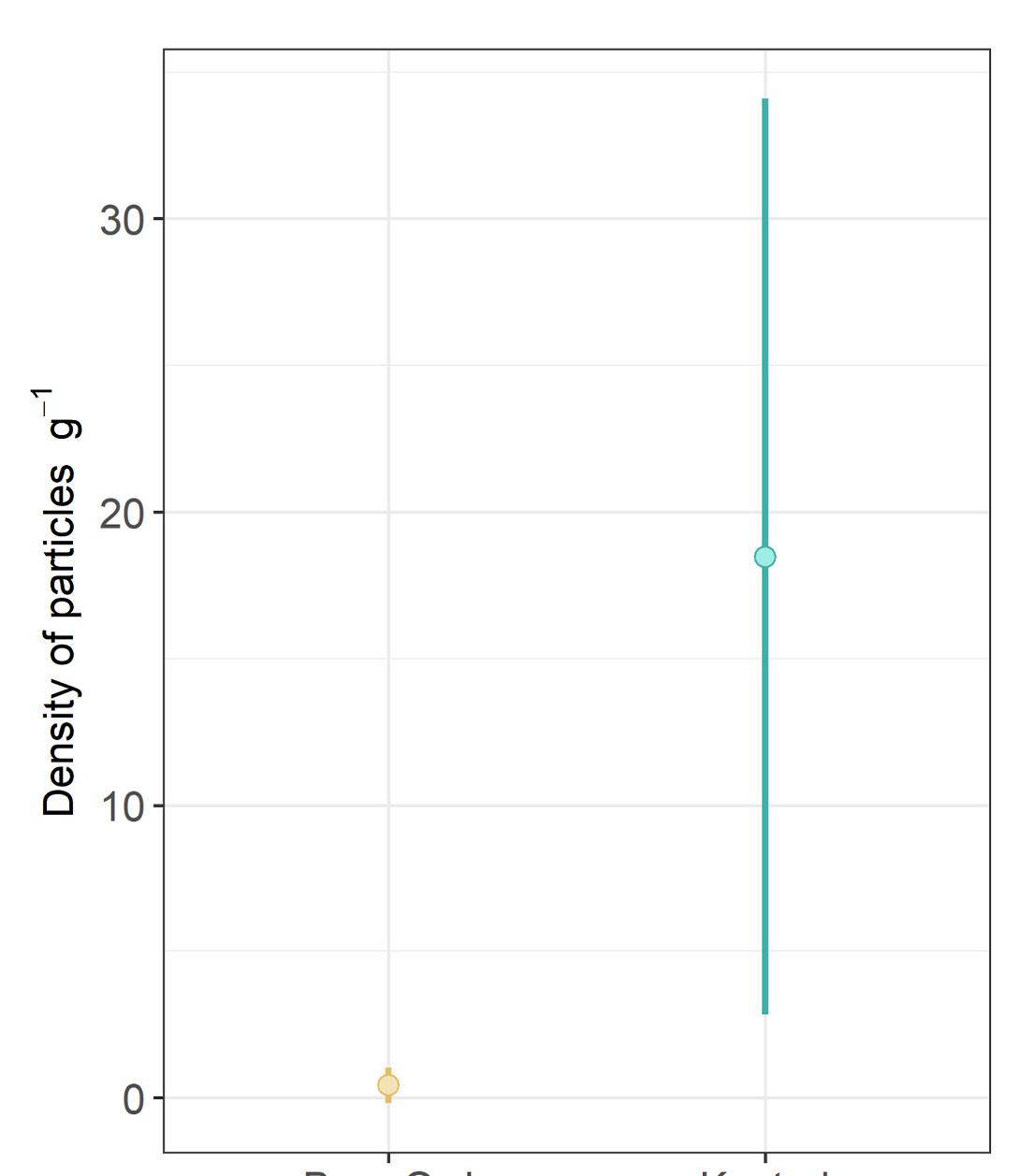
The two raptors use overlapping farmland and grassland habitats and both feed heavily on small mammals, but the authors found clear differences in the polymer profiles of their pellets. They suggest that variation in prey, foraging location and digestion could contribute to the species difference, while noting that their study did not analyse the diet of each pellet directly. They also caution that the much larger mass of barn owl pellets can dilute particle counts per gram. To check how much this affected the comparison, they estimated the total particles in an average pellet: about 17.0 for kestrel and 3.8 for barn owl. The difference therefore remained even without expressing the result per gram, although it was less extreme.
The pellets provide a non-invasive measure of dietary microplastic exposure, not a measure of plastic retained inside the birds. The authors explicitly note that pellets contain egested material and therefore cannot be used to estimate the quantity of microplastics remaining in body tissues.
Ecology
Related news

Kestrels Had More Densely Packed Mucous Glands Than Storks
A small study in Türkiye found roughly twice the density of mucus-producing glands in common kestrels’ windpipes as…
Read story →
No Common Kestrels Were Recorded at Rani for Three Consecutive Winters
Fourteen winters of surveys at Rani in Assam produced 422 common kestrel records, but sightings declined after 2020…
Read story →
Winter Surveys Estimated 5.59 Common Kestrels and 2.61 Common Buzzards per km² in Parma Farmland
Roadside distance sampling in northern Italy estimated 5.59 common kestrels and 2.61 common buzzards per km², while the…
Read story →SPECIES IN THIS STORY
Species in this story
Independent research and conservation news archive
Did you find this information useful?
Wildlife Vagabond is independently built and maintained. Voluntary support helps cover source verification, hosting and continued work on research and conservation news.
Support Wildlife VagabondThe news archive will remain freely available.