
Microplastics Were Found in All Studied Cormorant Nestlings and Were Linked to Gut Microbiota

Microplastics were detected in every great cormorant (Phalacrocorax carbo) nestling examined in a 2026 study of wild birds at two early developmental stages. Researchers combined microplastic measurements with 16S rRNA sequencing, a method used to profile the composition of bacterial communities, to investigate whether exposure was associated with the developing gut microbiota.
The researchers examined ten naturally deceased nestlings collected in Longfeng Nature Reserve, Heilongjiang, China, in May and June 2024. Five were at the downy feather stage and five at the emerging pin-feather stage. Samples came from intestinal contents and tissue.
The bacterial communities were dominated by Firmicutes, Proteobacteria and Fusobacteria. Microplastics were measured with laser-direct infrared imaging, allowing the researchers to characterize their abundance, polymer diversity and particle size.
Associations changed with developmental stage
The abundance, diversity and size of microplastic particles were significantly associated with both alpha diversity — the diversity of bacteria within each sample — and the broader composition of the gut microbiota. These relationships differed between the two developmental stages, indicating that the association between microplastics and the microbial community changed as the nestlings developed.
Microplastic concentrations themselves also varied between developmental stages, but that difference was not statistically significant. The study therefore does not support a simple conclusion that one age group contained more microplastics than the other.
Predicted microbial function also depended on developmental stage
The predicted functional profile of the gut microbiota — an estimate of the metabolic and other functions the bacterial community may perform based on its composition — was significantly influenced by developmental stage. The effects associated with microplastics depended on their interaction with developmental stage rather than showing a uniform independent effect across all nestlings.
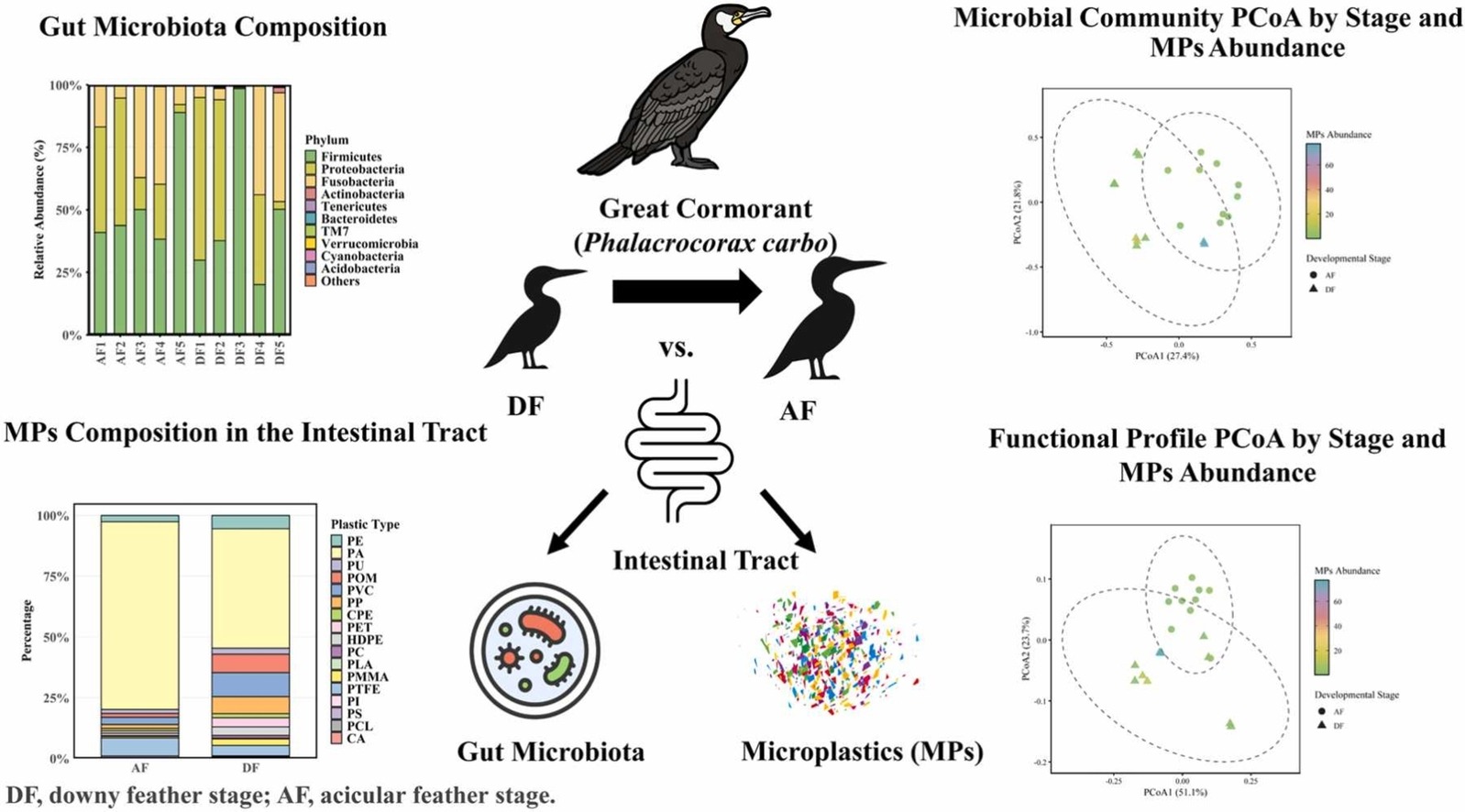
The authors interpret the results as evidence that environmental microplastic exposure can influence the developing gut microbiota of wild great cormorant nestlings, but they also call for further research to determine the mechanisms involved and whether the observed microbiota changes have long-term consequences for individual health.
Disease, parasites & microbiology
Related news

Great Cormorants Increased as Southern Baltic Diving Seabirds Stayed 40% Below Early-1990s Levels
A 35-year analysis of Polish Baltic winter surveys found strong growth in great cormorants, while the wider diving-seabird…
Read story →
European Inventory Estimated More Than €670 Million in Annual Fish Damage From Great Cormorant Predation
A 2026 European inventory using information from more than 300 organizations estimates annual cormorant-related damage to fish stocks…
Read story →
Estimated Great Cormorant Predation Reached 52–88% in Tagged Cod and 14–84% in Tagged Flounder
In Genner Bay, Denmark, a PIT-tag study estimated that great cormorants consumed 52–88% of tagged cod and 14–84%…
Read story →SPECIES IN THIS STORY
Species in this story

Independent research and conservation news archive
Did you find this information useful?
Wildlife Vagabond is independently built and maintained. Voluntary support helps cover source verification, hosting and continued work on research and conservation news.
Support Wildlife VagabondThe news archive will remain freely available.