
Pine Mires Stood Out as Early-Spring Habitat for Willow Tits in Managed Finnish Forests

Pine mires stood out as important early-spring habitat for willow tits (Poecile montanus) in a large acoustic survey of managed boreal forest in southwestern Finland. The study, published online on 29 April 2026, examined the period when birds are establishing territories before breeding.
Researchers placed autonomous sound recorders at 285 forest sites and surveyed them from 16 March to 25 April 2020. Willow tit presence was then compared with forest structure and landscape features within buffers with radii of 100 and 400 metres around each recorder.
Pine Mires and Deadwood Estimates
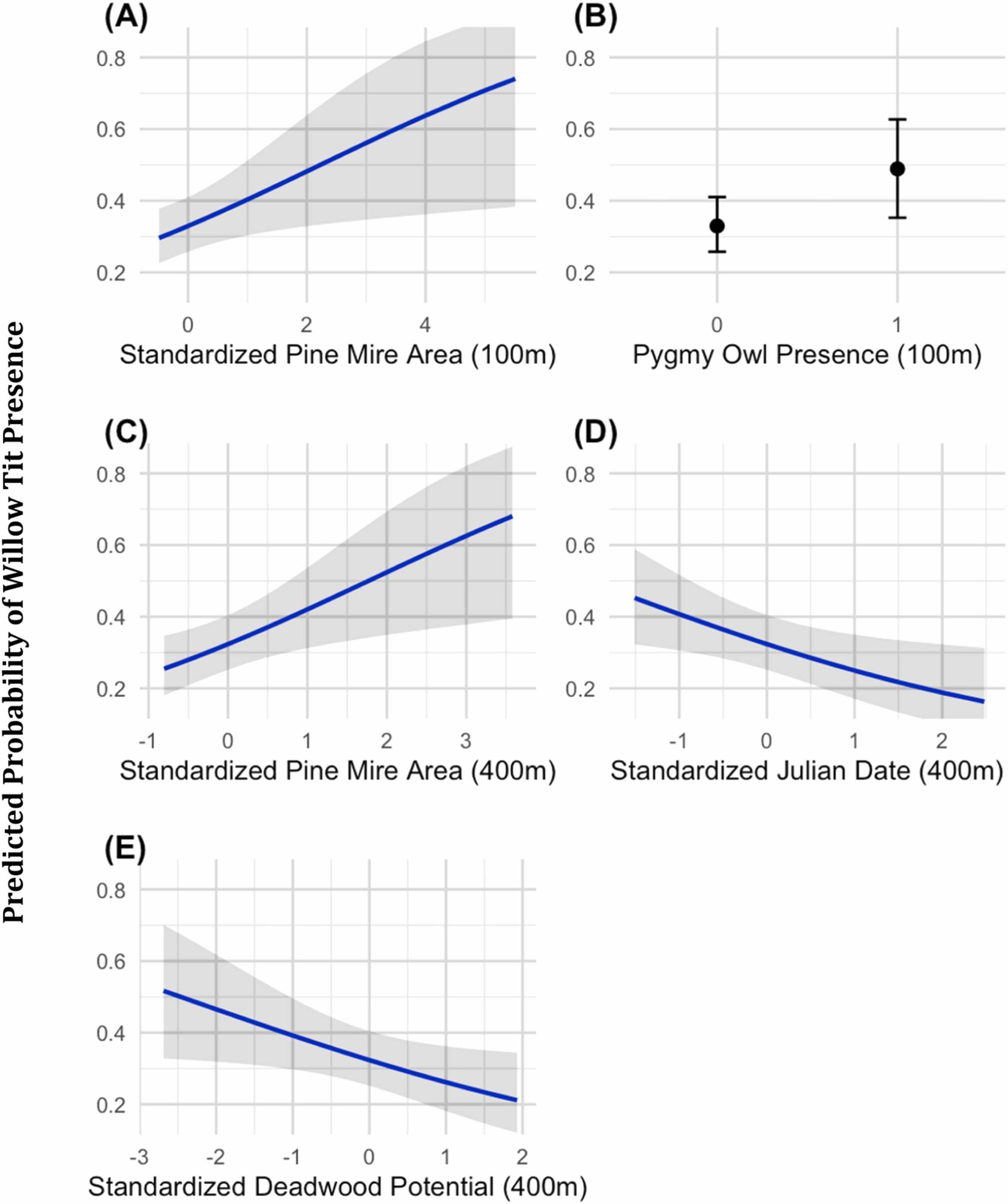
At both spatial scales, willow tits were more likely to occur where a larger area of pine mire was present. These peatland forests are dominated by Scots pine and retain moist conditions that can support decaying wood and spring food resources. The acoustic detections indicate the presence of singing, presumably territorial birds around the recorders, but do not identify actual nest locations within the habitat. At the 100-metre scale, willow tit presence was also positively associated with Eurasian Pygmy Owl (Glaucidium passerinum) detections; this association was not clear at 400 metres.
The researchers did not find a positive association with the amount of forest older than 80 years. Modelled deadwood potential also failed to show the expected positive relationship and had a weak negative association at the broader scale. The authors stress that these landscape-level estimates do not describe the fine qualities of decaying wood that willow tits actually need, such as soft standing snags suitable for excavating nest cavities.
Spring Food Resources
The study focused specifically on the pre-breeding period. The authors suggest that pine mires may be valuable at this time not only because of their structure, but also because pine-dominated habitats can provide seeds when winter food stores are running low. This may help explain why the early-spring pattern differs from habitat relationships found during breeding.
Detection probability declined as spring progressed, which the researchers attribute to seasonal changes in vocal activity as territory establishment gives way to breeding.
The authors recommend that pine mires and other peatland features be incorporated explicitly into forestry planning for the species.
Ecology
Related news

Natural England Funded Development of a National Willow Tit Recovery Strategy
Natural England funded a 2026–2029 project to build a national recovery strategy for willow tit across several English…
Read story →
Mean Eurasian Blue Tit Winter Count Rose Fourfold in Finnish Urban Survey Plots
Across 31 Finnish settlements, mean Eurasian blue tit counts rose from 2.8 birds per standardised urban plot in…
Read story →
Wet Willow Wildlife Improved 51 Hectares of Wet Woodland and Connected 632 Hectares
The two-year Wet Willow Wildlife project in northwest England improved 51 hectares of wet woodland, increased connectivity across…
Read story →SPECIES IN THIS STORY
Species in this story

Independent research and conservation news archive
Did you find this information useful?
Wildlife Vagabond is independently built and maintained. Voluntary support helps cover source verification, hosting and continued work on research and conservation news.
Support Wildlife VagabondThe news archive will remain freely available.