
Drone Surveys Produced Similar Nest Survival Estimates to Ground Surveys for Florida Waterbirds
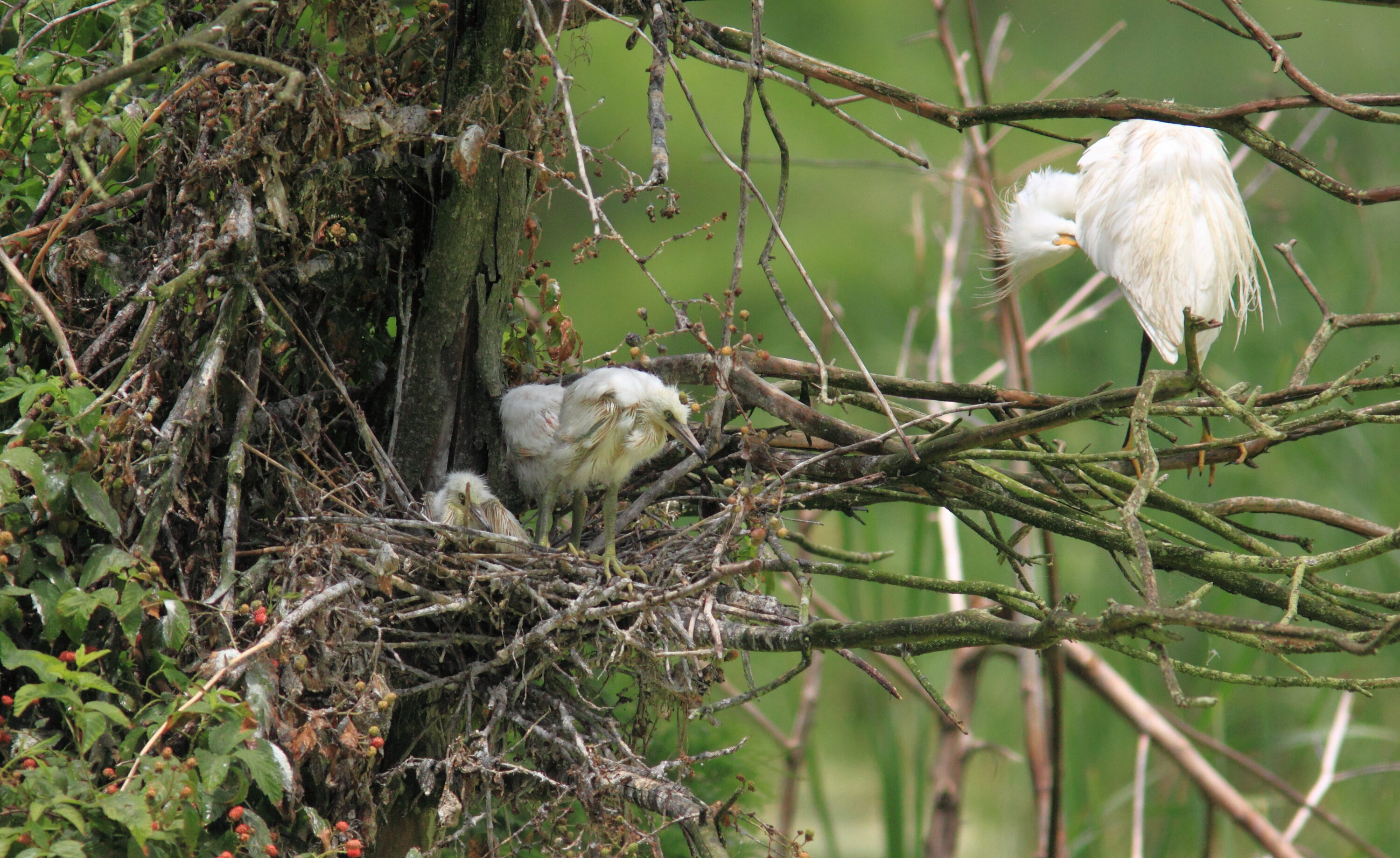
At four breeding colonies around Lake Okeechobee in Florida, USA, researchers tested whether drone imagery could estimate nest survival as reliably as repeated visits by observers on the ground. The comparison covered colonial waterbirds nesting in swamp habitat, where dense tree and shrub canopy can make nests difficult to see from above.
Nest survival here means the probability that a nest remains successful long enough to produce at least one fledgling. Estimating it requires researchers to relocate individual nests repeatedly through the breeding season, making this a more demanding test of drone monitoring than simply counting visible nests.
More than 500 nests were followed with each method
During the 2021 breeding season, ground surveys followed 563 nests and drone surveys followed 510. The largest sample was snowy egret (Egretta thula), with 307 nests monitored from the ground and 300 in drone imagery. The datasets also included great egret (Ardea alba), tricolored heron (Egretta tricolor), western cattle egret (Ardea ibis), glossy ibis (Plegadis falcinellus), white ibis (Eudocimus albus) and little blue heron (Egretta caerulea).
The drone flew 76 metres above the colonies and captured overlapping photographs that were combined into geometrically corrected orthomosaic images. Because nests could be relocated at the same mapped positions on later flights, researchers could reconstruct individual nest histories from repeated images. Ground surveys recorded the same kinds of information directly at marked nests.
Daily nest survival was estimated with logistic-exposure models, which account for the fact that nests were not always checked after exactly the same number of days. The resulting daily probabilities were then used to estimate survival across the nesting period.
Overall estimates differed by less than one percentage point
Across species and colonies, overall nest survival estimates differed by only 0.59 percentage points between drone and ground methods. For snowy egret, the drone estimate was 0.51 percentage points lower than the ground estimate, and differences among individual colonies ranged from zero to 2.5 percentage points. Great egret also showed close agreement between methods.
The match was weaker for darker birds. For dark-plumaged species pooled, the drone-derived survival estimate was 5.7 percentage points lower than the ground estimate, while tricolored heron showed a 2.68-point difference overall and substantially larger differences at some colonies.
Canopy and plumage affected what the camera could see
The authors link the weaker performance for dark-plumaged birds to visibility rather than to a biological difference in nest survival. Dark adults and nestlings had less contrast below dense canopy, where they could blend into the dark water or be mistaken for shadows. Moonshine Bay, which had greater canopy cover than the other colonies, also produced greater disagreement for some comparisons.
Drone images had one practical advantage when chicks became mobile. During ground surveys, chicks older than about 14 days could no longer always be assigned confidently to a particular nest. Because the drone did not require researchers to approach the nest, chicks could remain associated with a nest in the imagery until about 21 days of age.
The study therefore supports drones as a workable method for estimating nest survival in canopied waterbird colonies, but not as an equally accurate tool under every condition. White-plumaged species such as snowy and great egrets were monitored more consistently than darker species under dense cover. The authors also note that drones can reduce direct disturbance compared with repeated ground entry when they are flown at appropriate altitudes and according to established best practice; disturbance itself was not separately quantified in this comparison.
Other research
Related news

Great Egret Nesting Pairs Increased 96% While Black-crowned Night Herons Fell 55% in New York–New Jersey Harbor
A 22-year study found that great egret nesting pairs in New York–New Jersey Harbor increased 96% and snowy…
Read story →
Snowy Egrets Made Up 73% of Herons Counted on Venezuela’s Santa Rita Coast
Monthly surveys on Venezuela’s Lake Maracaibo coast counted 1,793 snowy egrets—73% of all herons recorded—with the species using…
Read story →
Six of Seven GPS-Tracked Great Egrets Returned to the Same Wintering Grounds
Six of seven great egrets tracked across at least two complete winters returned to the same wintering grounds;…
Read story →SPECIES IN THIS STORY
Species in this story

Independent research and conservation news archive
Did you find this information useful?
Wildlife Vagabond is independently built and maintained. Voluntary support helps cover source verification, hosting and continued work on research and conservation news.
Support Wildlife VagabondThe news archive will remain freely available.