
Echinococcus multilocularis Was Detected in 5.7% of Sampled Golden Jackals Across Serbia

The tapeworm Echinococcus multilocularis was detected in seven of 122 sampled golden jackals (Canis aureus) from Serbia, a prevalence of 5.7% in the examined material. The study, published on 30 April 2026, sampled legally hunted jackals from 25 hunting grounds in different parts of the country to map which Echinococcus species were circulating in this expanding canid.
The researchers examined intestinal mucosa and faecal material for adult tapeworms and eggs and used species-specific PCR to identify the parasites. The animals had been hunted between October 2023 and February 2025.
E. multilocularis was found in seven animals, while Echinococcus canadensis G6-8,10 was detected in two and Echinococcus granulosus sensu stricto G1/3 in one. Overall, ten of the 122 jackals carried Echinococcus eggs.
The positive E. multilocularis records were distributed across several parts of Serbia. The researchers identified areas with multiple positive findings around Niš in the south and around Čačak and Mount Zlatibor in the west. Three of the seven infected jackals came from hunting grounds close to the cities of Niš and Čačak.
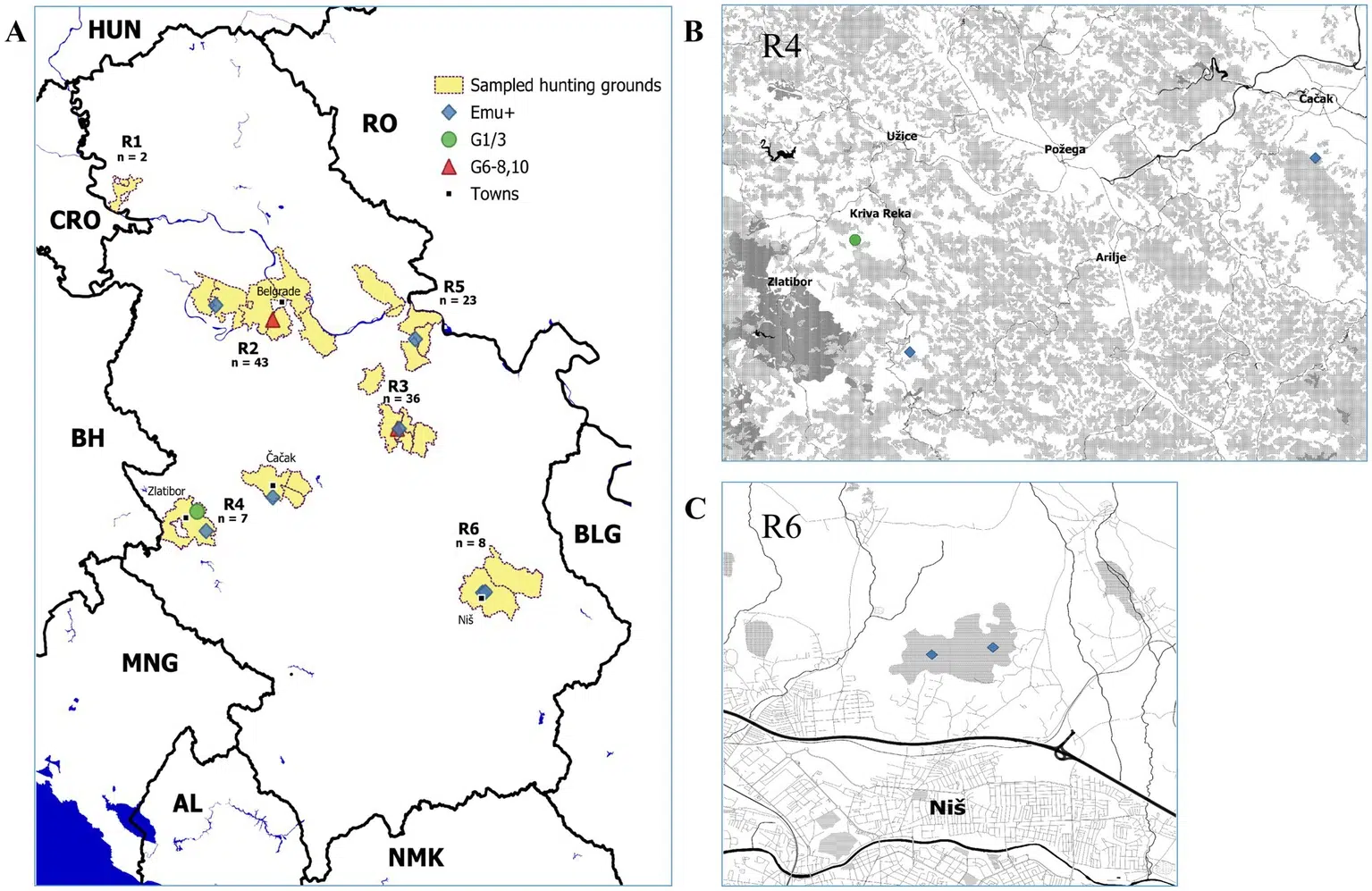
Sampling did not cover Serbia evenly
The authors stress that the numbers should not be interpreted as a national prevalence estimate. Sample sizes differed substantially among hunting grounds, some regions were represented by very few animals, and Serbia lacks reliable regional or national estimates of golden jackal abundance and density.
Because jackals can also move beyond the hunting grounds where they are sampled, the observed distribution may not represent the full geographical spread of the parasite. The study therefore provides evidence of occurrence across several parts of Serbia rather than a complete epidemiological map.
E. multilocularis can cause alveolar echinococcosis in people, while canids act as definitive hosts that shed eggs into the environment. People can become infected by accidentally ingesting these eggs from contaminated food or the environment; the larval stage then grows mainly in the liver as infiltrating, cyst-like lesions. Golden jackals have increased in number and expanded their range across Europe, including human-modified landscapes.
The authors argue that the jackal’s role in maintaining and distributing the parasite should therefore be included in Serbian surveillance. They recommend systematic monitoring of golden jackals for E. multilocularis, particularly in regions with large or dense jackal populations.
Disease, parasites & microbiology
Related news

Similar Mammal Diversity, Different Activity Patterns in Grazed and Ungrazed Areas
Camera traps in four northern Israeli reserves found similar numbers of mammal species with and without livestock grazing.…
Read story →
Climate Best Explained Fine-Scale Genetic Connectivity in Expanding Golden Jackals
A Eurasian landscape-genomics study of 363 golden jackals found that geography dominated genetic structure at continental scale, while…
Read story →
Most New Golden Jackal Samples Around the Adriatic Matched the Pannonian Genetic Cluster
Microsatellite analysis of 27 new golden jackal samples from Croatia, Italy, Austria and Greece assigned most animals to…
Read story →SPECIES IN THIS STORY
Species in this story

Independent research and conservation news archive
Did you find this information useful?
Wildlife Vagabond is independently built and maintained. Voluntary support helps cover source verification, hosting and continued work on research and conservation news.
Support Wildlife VagabondThe news archive will remain freely available.