
Short-eared Owls Wintering in Taiwan Used Two Distinct Spring Migration Routes
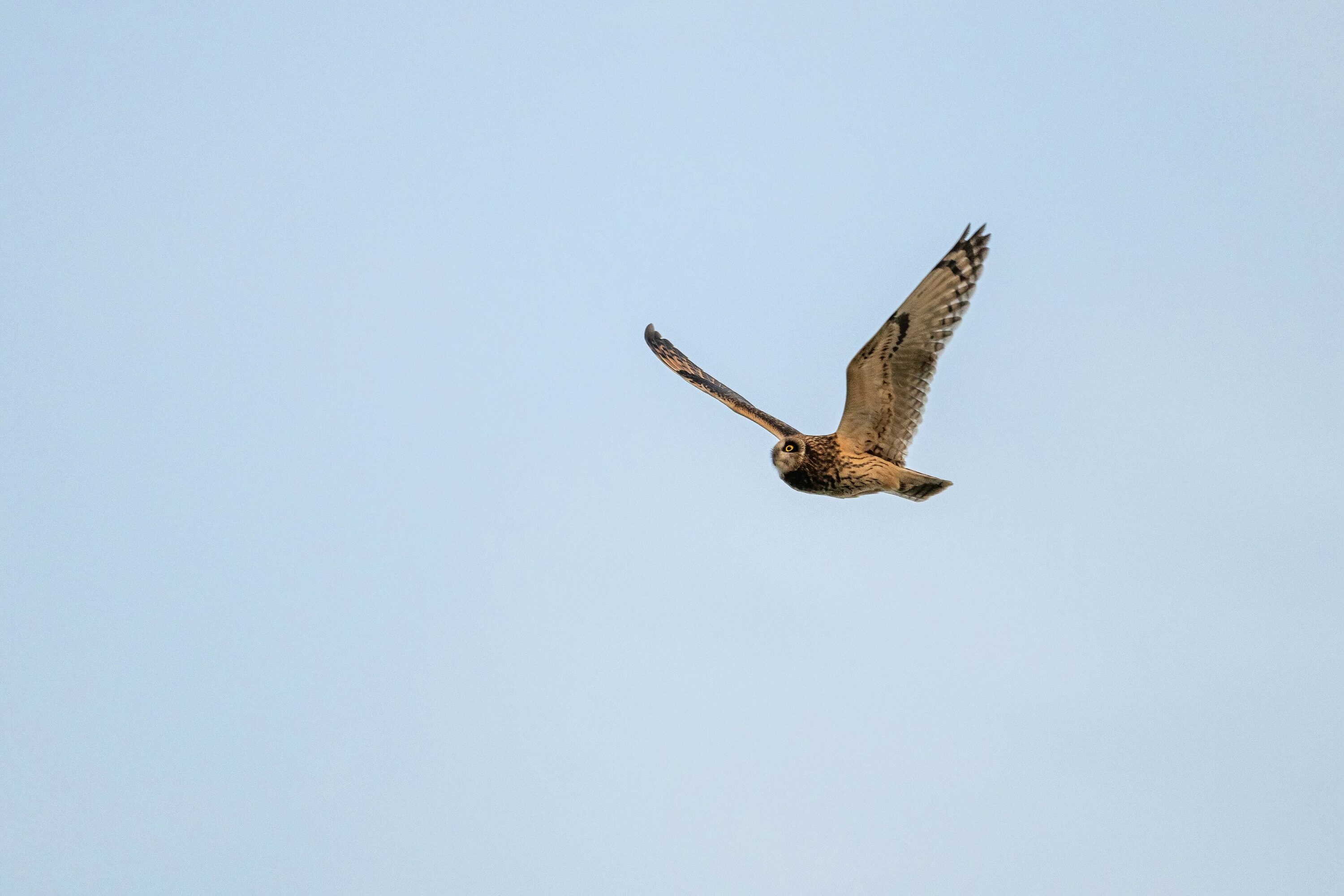
GPS tracking of Short-eared Owls (Asio flammeus) wintering in Taiwan revealed two distinct spring migration routes through East Asia. Of 27 owls fitted with solar-powered transmitters between 2018 and 2025, 17 departed Taiwan in spring. Eleven followed the East Asian Continental Flyway through eastern China, while six used the East Asian Oceanic Flyway via the Ryukyu Islands, Japan and the Korean Peninsula.
The owls had originally been rescued during runway-netting operations at Taiwanese airports. After veterinary assessment and rehabilitation, transmitters were fitted shortly before release at off-site locations away from the airfields. The study was published online in July 2026 in Journal of Raptor Research.
Eleven owls crossed toward mainland China
The continental route was used by 11 of the 17 owls that began spring migration. These birds crossed the Taiwan Strait from northwestern Taiwan to Zhejiang or Jiangsu in eastern China, then continued north across or around the Yellow Sea and Bohai Sea toward northeastern China and Russia.
Five continental-route owls provided complete northward tracks to the study’s defined onset of summer residency. Their migrations lasted about 37 days on average and covered 1,633–3,965 km. The largest recorded displacement in a single day among these completed continental tracks was 835 km.
Six owls used an island-hopping oceanic route
Six owls took a different path. They left northern or northeastern Taiwan toward the Ryukyu Islands, continued through Kyushu and Jeju Island in South Korea, crossed the Tsushima Strait to the Korean Peninsula and then moved toward northeastern China and Russia. The island chain offered a series of potential landfalls along a route with substantial over-water travel.
Two of these oceanic-route owls first crossed Taiwan’s Central Mountain Range from west to east before heading offshore. The range exceeds 3,000 metres, making this an especially striking first stage of migration.
The oceanic tracks were much less complete than the continental ones. Only one of the six reached the study’s definition of summer settlement. That bird migrated for 29 days and covered 4,275 km. Other oceanic-route transmitters stopped before a complete spring migration could be documented.
The farthest tracked owl reached northeastern Russia
Across both route types, spring departures ranged from 2 April to 29 May. The farthest-tracked individual left Taiwan on 2 April 2024 and reached its northernmost recorded location near Chersky in northeastern Russia on 24 May. Its recorded route totalled 5,901 km over 53 days.
The largest one-day displacement in the entire dataset was 1,154 km and occurred on an oceanic-route track. The authors note that such long sea movements are consistent with the possibility of wind-assisted flight, but the transmitters usually supplied no more than one location per day, so the study could not test fine-scale relationships between wind conditions and route decisions.
Six complete tracks do not represent all 17 departing birds
Tracking completeness is central to interpreting the study. Ten of the 27 tagged owls stopped transmitting before spring departure. Of the 17 that did leave Taiwan, 11 stopped transmitting during northward migration and six reached the defined summer residency period. Route classification was still possible for all 17 because their early migration paths distinguished the continental and oceanic flyways.
Because locations were not available every day for every owl, the calculated travel distances are minimum estimates and can underestimate actual movement. The imbalance between route classes was also strongest at the level of complete tracks: five complete continental migrations versus only one complete oceanic migration.
The two routes show flexible migration from one wintering region
The study provides the first telemetry-based description of spring migration routes and northern termini for Short-eared Owls wintering in Taiwan. Birds from the same wintering region did not all use the same geographical strategy: some moved toward mainland China almost immediately, while others undertook a sequence of island and sea crossings before rejoining northeastern Asian land routes.
The authors place this flexibility in the context of a species known for nomadic movements and relatively low site fidelity. They suggest that the Ryukyu–Kyushu–Jeju chain may provide stepping-stone landfalls for the oceanic route, while the continental route offers a more direct connection to mainland East Asia. They do not identify a single mechanism that determines which route an individual takes.
Future work should improve transmitter choice and selection of individuals to increase track completeness and allow stronger comparisons between migration strategies. The authors also emphasise conservation of wintering and stopover habitats along both flyways, because Taiwan-wintering owls connect the island with sites across China, Japan, South Korea and Russia.
Ecology
Related news

Western Finland’s Short-eared Owl Breeding Population Fell More Than 50% as Grassy Habitat Shrunk 46%
Over 47 years in western Finland, the local Short-eared Owl breeding population fell by more than 50% while…
Read story →
Galápagos Short-eared Owls Shared Volcanic Dust Baths on Floreana
Camera traps and field observations on Floreana documented repeated use of fine volcanic dust baths by Galápagos Short-eared…
Read story →
Only 2% of the Southern Québec Study Area Was Classified as Very High-Quality Short-eared Owl Breeding Habitat
A 2026 Québec study found that only about 2% of the modelled area fell in the highest breeding-habitat…
Read story →SPECIES IN THIS STORY
Species in this story

Independent research and conservation news archive
Did you find this information useful?
Wildlife Vagabond is independently built and maintained. Voluntary support helps cover source verification, hosting and continued work on research and conservation news.
Support Wildlife VagabondThe news archive will remain freely available.