
Woodland Caribou Selected Regenerating Clearcuts With More Forage and Higher Predator Activity
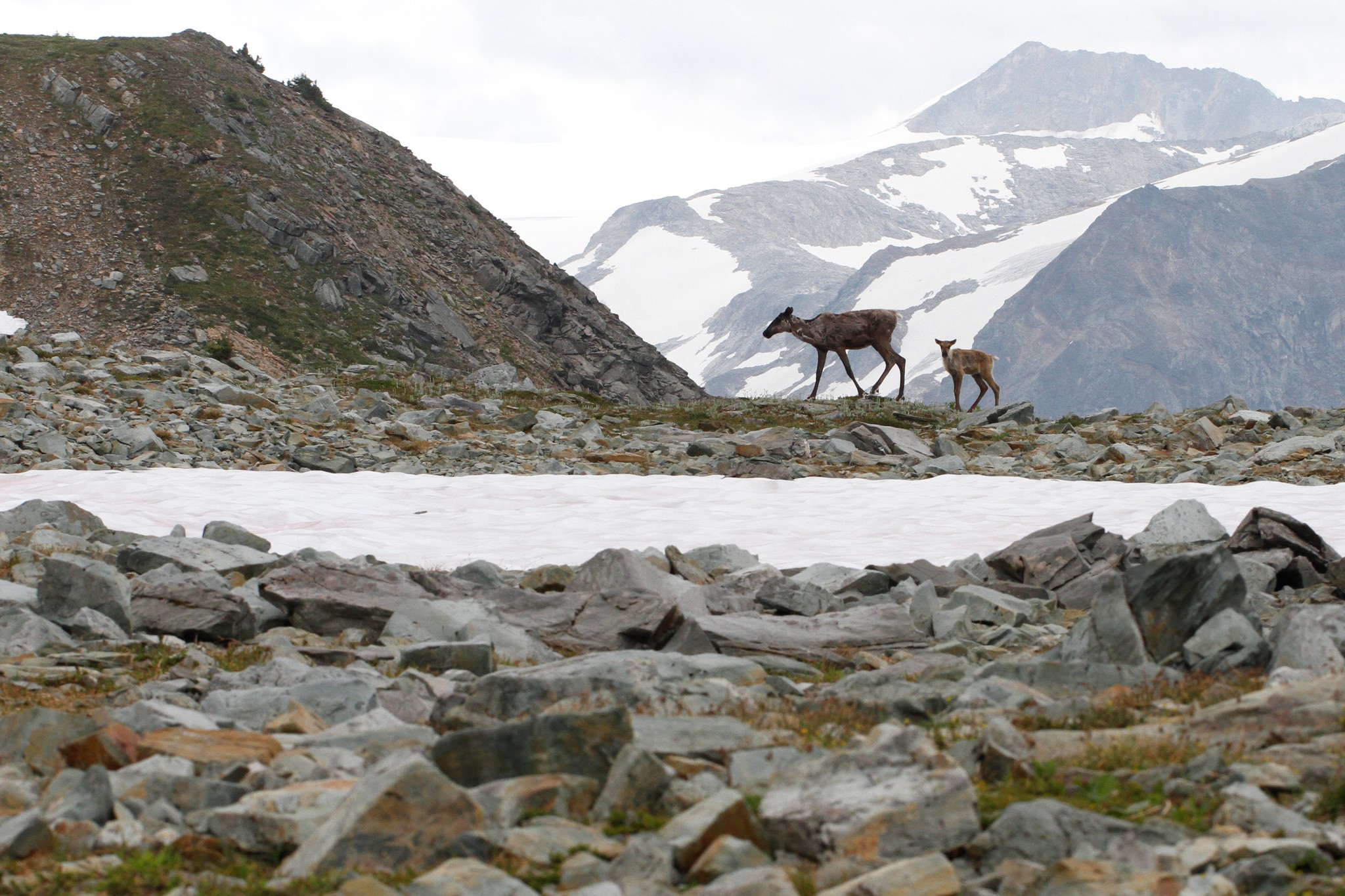
Woodland caribou (Rangifer tarandus caribou) in west-central British Columbia, Canada selected regenerating forestry clearcuts during summer even though the same landscape features were associated with greater activity by some predators. The study tested whether these clearcuts could act as ecological traps: habitats that attract animals with useful cues or resources but ultimately impose lower fitness through reduced survival or reproductive success.
The researchers examined three parts of that hypothesis. Caribou would have to select clearcuts at least as strongly as alternative habitats; the clearcuts would need to provide comparable or better forage; and using them would need to carry a fitness cost. The study found clear evidence for the first two patterns and indirect evidence of greater predation risk, but it did not measure the final fitness consequence directly.
GPS data showed selection for clearcuts up to 25 years old
The habitat-selection analysis combined 71 summer GPS tracking records contributed by caribou across different years, divided among females with calves, females without calves and males. The final data came from 2012–2014 and 2019–2021.
All three classes selected areas with a higher proportion of regenerating clearcuts, defined as clearcuts up to 25 years old. Evidence for selection was strong in females and weaker in males. Females with and without calves showed broadly comparable selection, although females with calves generally showed the strongest tendency to select these areas among animals that moved into the peripheral summer range.
Older clearcuts, 26–39 years old, showed a different pattern. Females with calves and males avoided them, while their use by females without calves was neutral. The models indicated road avoidance in all three classes; evidence was strong for females and weaker for males.
Regenerating clearcuts had 1.7 times more combined forage cover
To test whether young clearcuts offered a nutritional attraction, the researchers surveyed vegetation at 56 paired clearcut and uncut plots. They combined cover of lichens, herbaceous forage and deciduous shrubs that could be eaten by caribou.
Regenerating clearcuts had 1.7-fold greater combined forage cover than paired uncut sites. Herbaceous forage was particularly greater in the young clearcuts, while lichen cover was lower. Older clearcuts no longer showed an overall advantage in combined forage cover over uncut areas.
This age difference matched the habitat-selection results: caribou selected the regenerating clearcuts that offered more combined forage but did not show the same attraction to older clearcuts without that overall forage advantage. The authors interpret this as support for a forage-driven mechanism behind the selection of young clearcuts.
Wolves and black bears used regenerating clearcuts more
Predator activity was assessed with 149 camera traps across the core and peripheral summer ranges. The analysis focused on wolves (Canis lupus), coyotes (Canis latrans), grizzly bears (Ursus arctos) and American black bears (Ursus americanus).
Wolf detections were positively associated with both regenerating and older clearcuts. Black bears were associated with regenerating clearcuts and roads, while coyotes were associated with roads rather than clearcuts. Grizzly bear activity was not associated with either clearcuts or roads in the models.
The researchers used predator habitat-use intensity as a proxy for predation risk. This showed that the regenerating clearcuts selected by caribou overlapped with greater use by wolves and black bears, but it did not measure individual encounters, kills or survival directly.
The evidence did not fully demonstrate an ecological trap
The study therefore satisfied two important predictions of the ecological-trap hypothesis: caribou selected regenerating clearcuts, and those clearcuts provided more combined forage. The predator results were also consistent with higher risk. What remained untested was the defining final step—whether individuals selecting those clearcuts actually experienced lower survival or reproductive success than caribou using alternative habitats.
The authors consequently describe the evidence as partial. They discuss other processes that could create the same pattern without maladaptive habitat choice. Risk-sensitive foraging, for example, could lead nutritionally constrained caribou to accept greater predation risk in exchange for better forage. Density-dependent habitat selection could also influence which animals move into peripheral summer range.
A supplementary historical analysis added another dimension. Compared with the 1980s, when clearcuts were largely absent, Itcha–Ilgachuz summer home ranges shifted toward areas containing regenerating clearcuts in later decades. The authors interpret this as further evidence that logging has altered the spatial distribution of summer resources and risks.
The authors recommend action even though the trap hypothesis is not fully demonstrated
Even without direct evidence of reduced fitness, the authors argue that selection of high-risk regenerating clearcuts represents a pathway that could contribute to caribou declines. They recommend limiting new clearcutting and improving protection of summer ranges.
They also call for future work that links individual habitat selection directly to survival or reproductive success. That evidence would be needed to determine whether the clearcuts are truly ecological traps or whether the observed behaviour instead reflects an adaptive trade-off between food and predation risk.
Ecology
Related news
Inuit harvesters help detect an emerging parasitic disease in Arctic caribou
Near Kugluktuk in Nunavut, Inuit harvesters reported unusual tissue changes in caribou. Tests found DNA from two parasitic…
Read story →
Video Collars Showed GPS Methods Were Only About 70% Accurate at Detecting Caribou Calving
Video collars from 160 adult females in the Porcupine and Western Arctic herds showed that two GPS movement…
Read story →
Reindeer and Caribou Showed Broad Genetic Differences Across Russia, Alaska and Canada
Microsatellite data from 1,544 reindeer and caribou in 42 populations showed broad genetic differentiation among Russia, Alaska and…
Read story →SPECIES IN THIS STORY
Species in this story
Independent research and conservation news archive
Did you find this information useful?
Wildlife Vagabond is independently built and maintained. Voluntary support helps cover source verification, hosting and continued work on research and conservation news.
Support Wildlife VagabondThe news archive will remain freely available.