
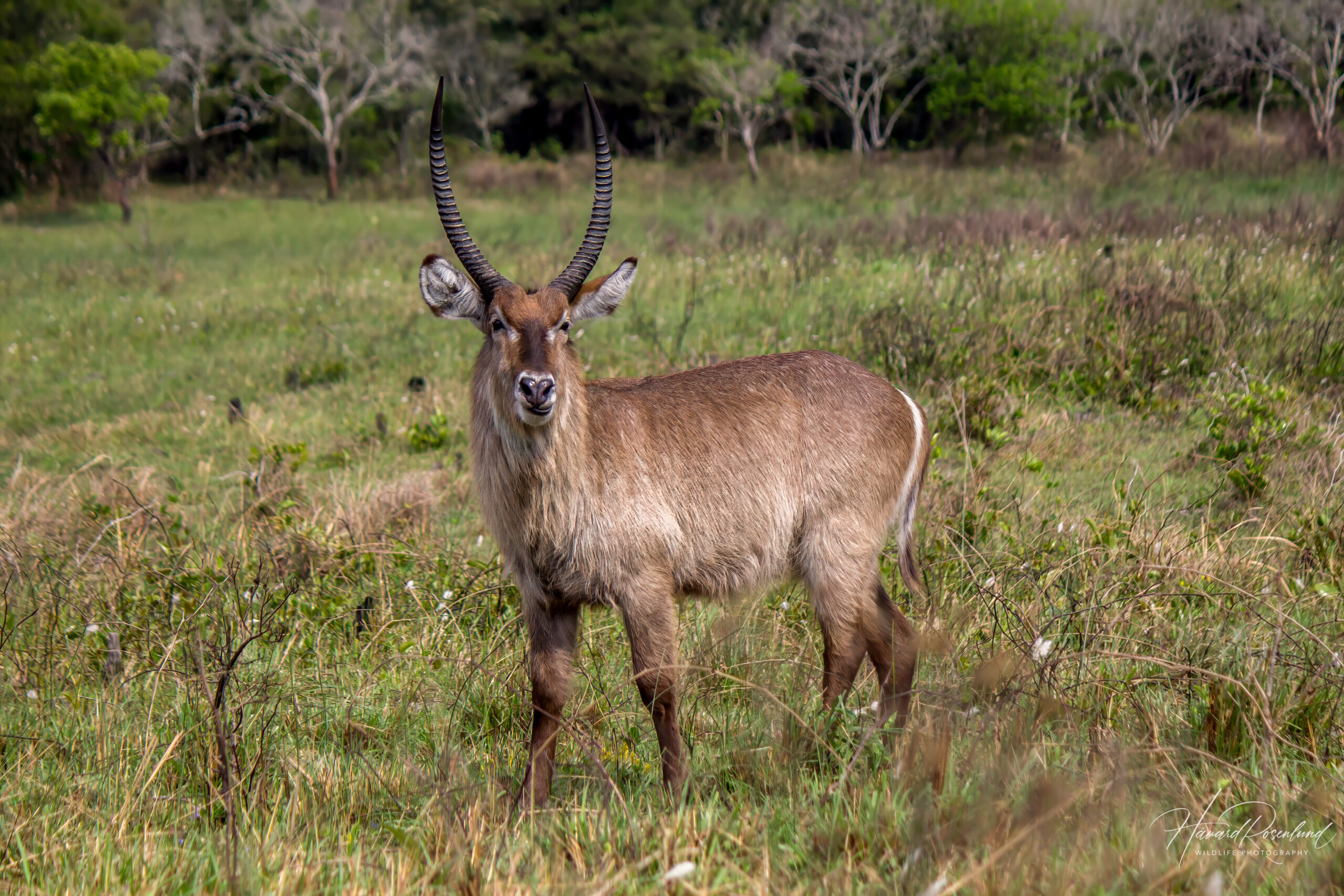
Waterbuck
Kobus ellipsiprymnus
At a glance
Habitat
- Moist grassland, savanna, floodplains and riverine woodland near permanent water
Diet
- Mainly grasses; herbs, leaves and occasional fruit when grass is scarce
Activity
- Mostly daytime, especially morning and late afternoon; also active at night
Size
- Length: 177–235 cm Weight: 160–300 kg
Range
- Sub-Saharan Africa, closely tied to permanent water
Description
The waterbuck (Kobus ellipsiprymnus) is a large, heavily built antelope with a long body, thick neck and coarse, shaggy coat. Adults measure about 177–235 cm from head to body, stand 120–136 cm at the shoulder and weigh roughly 160–300 kg. Males are around a quarter larger than females on average and generally become darker and more heavily built with age.
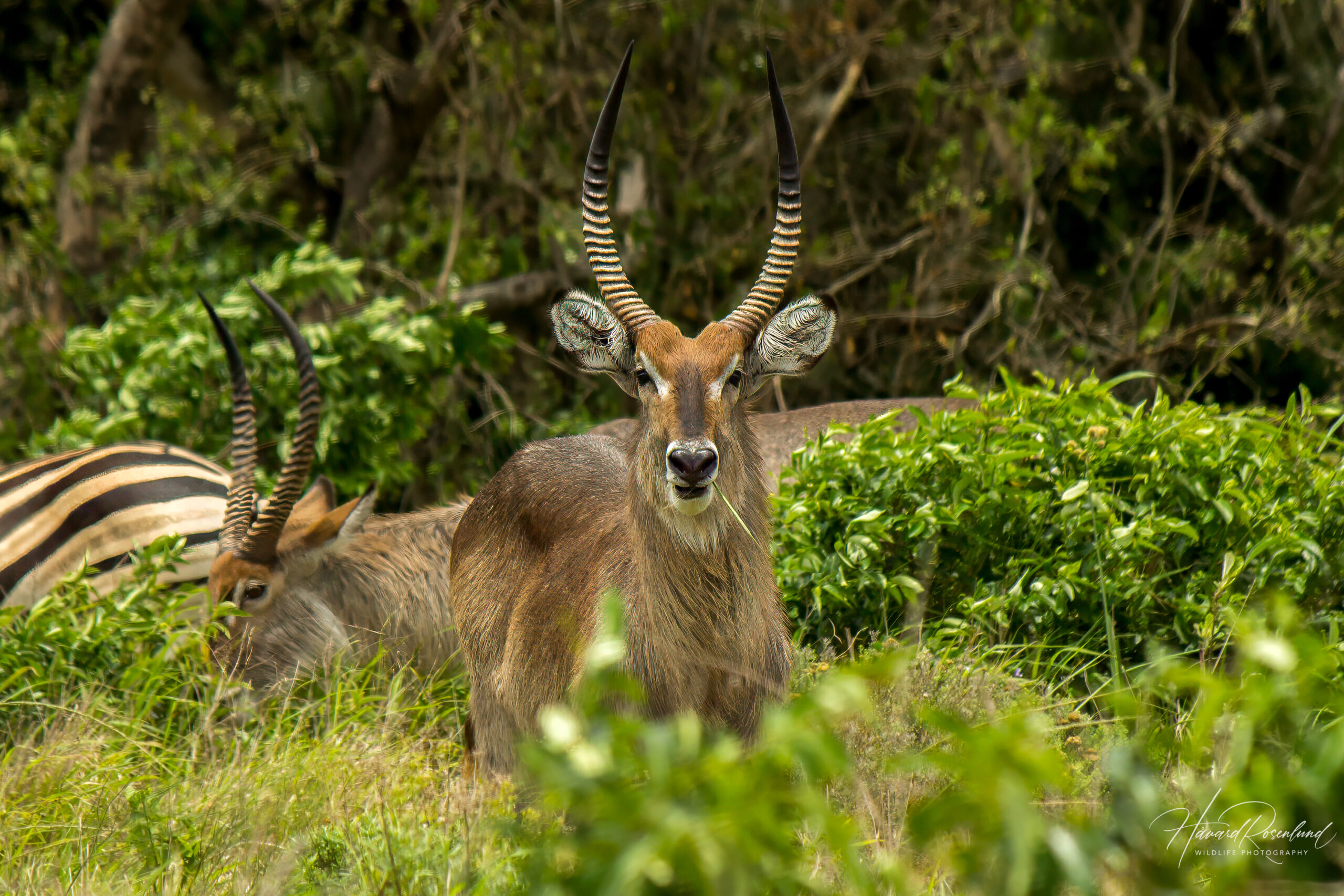
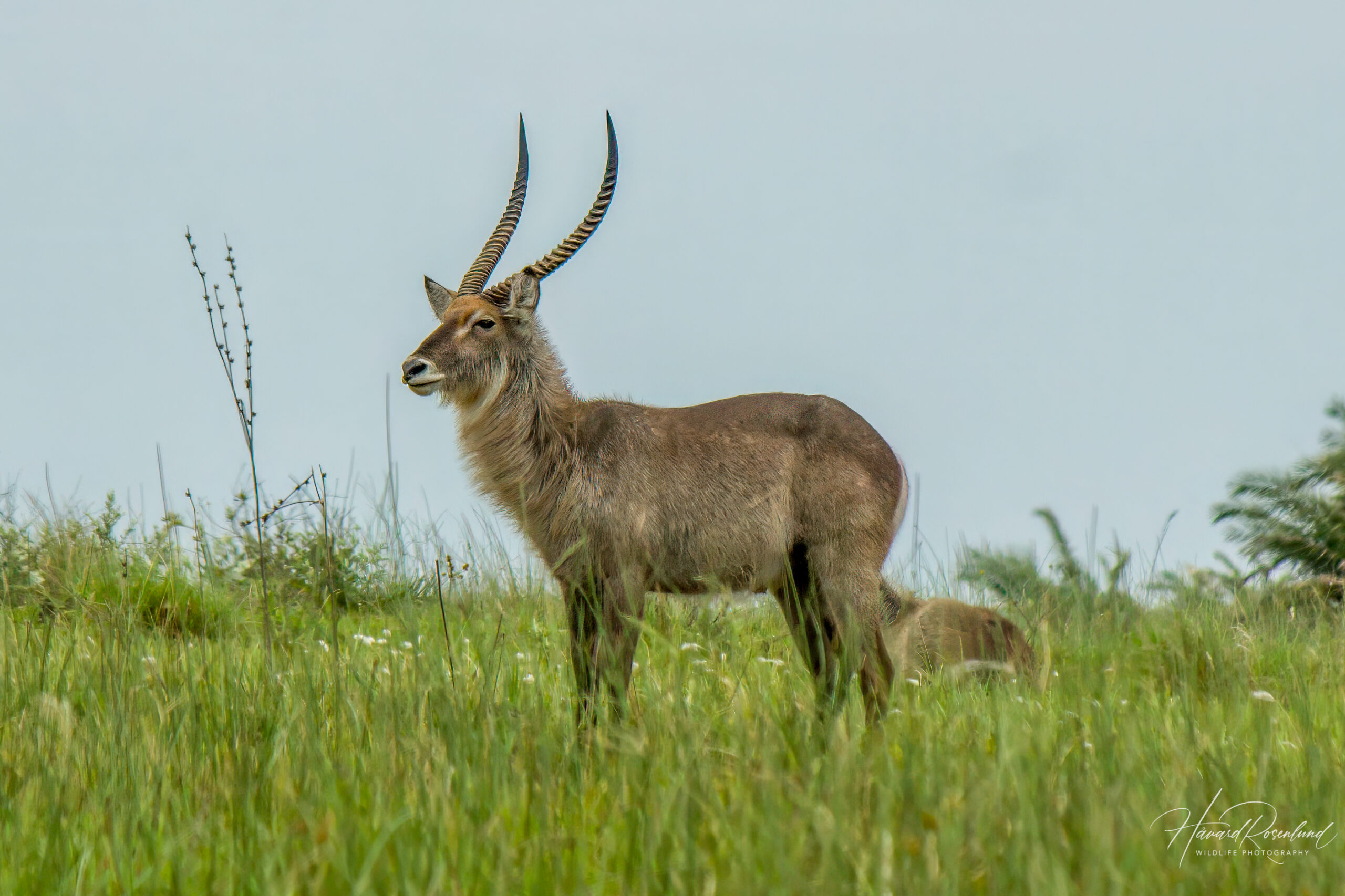
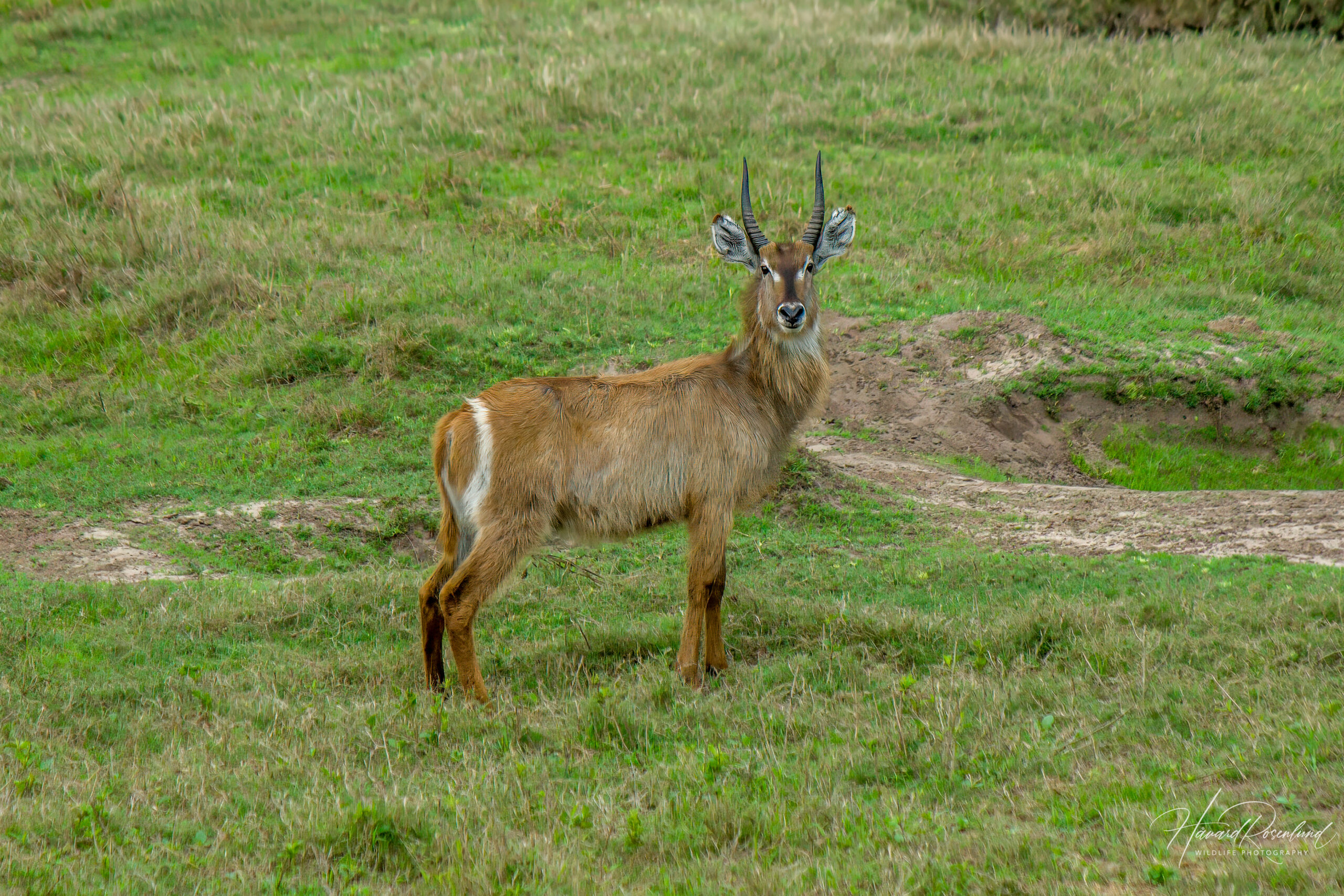
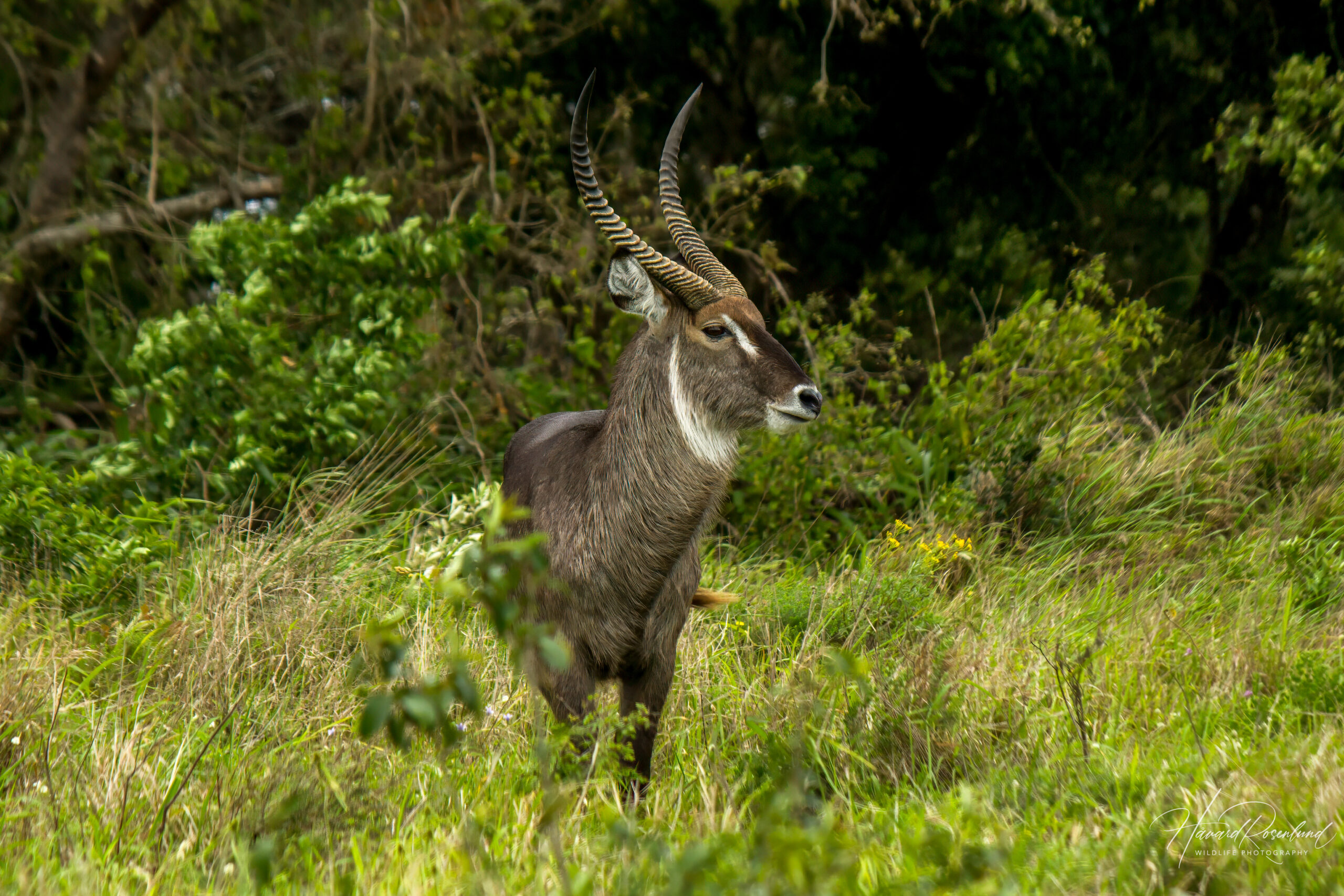
The coat varies from reddish brown to grizzled grey and forms a short mane along the neck. Both sexes have a white muzzle, pale markings above the eyes and a cream-coloured throat patch. The lower legs are dark with white rings above the hooves. Only males carry horns. These are strongly ridged, sweep backwards before curving forwards and usually measure 50–90 cm, with exceptional horns approaching 1 m.
Taxonomy
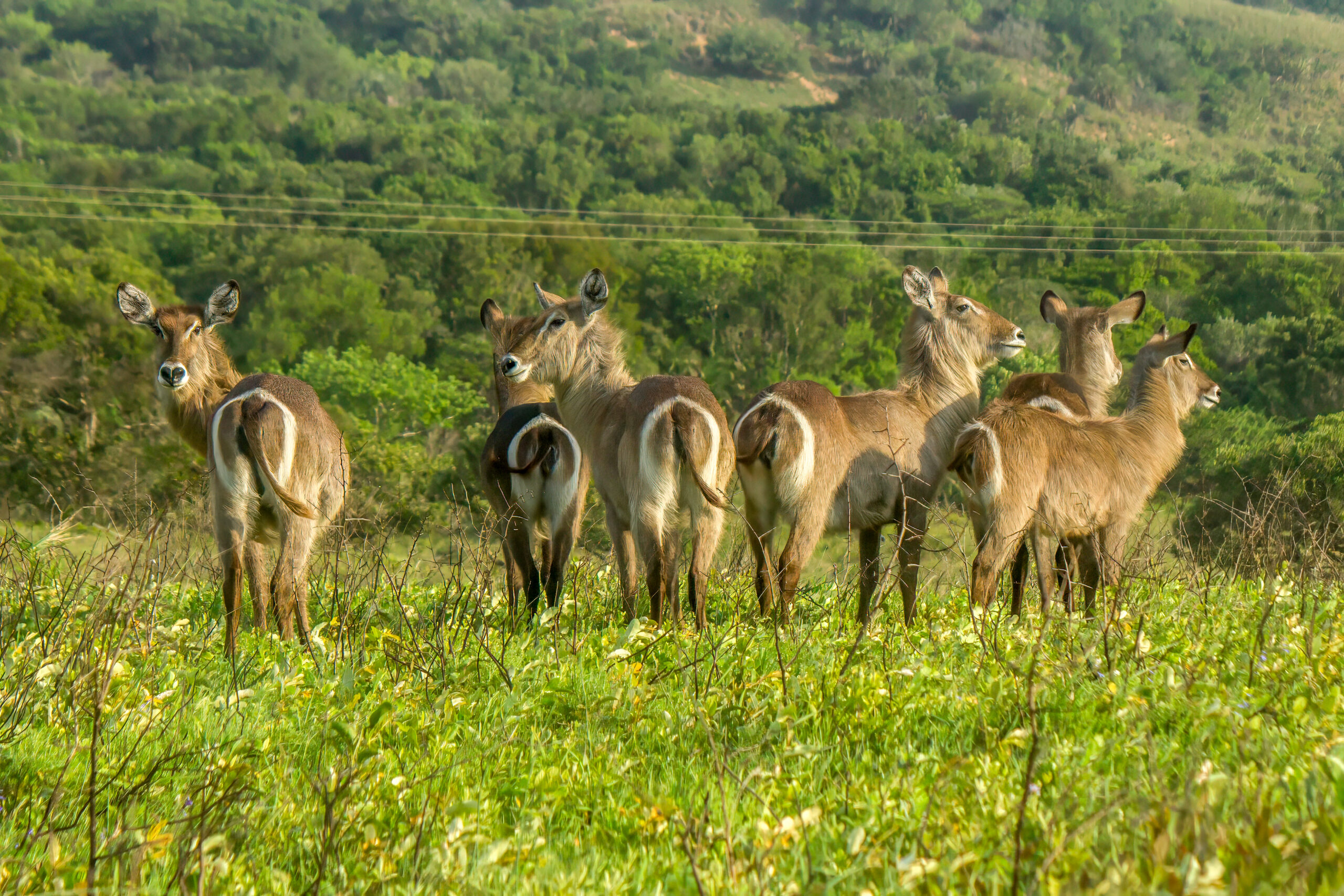
Two subspecies are generally recognised. The common waterbuck (Kobus ellipsiprymnus ellipsiprymnus) has the conspicuous white elliptical ring around the rump, while the defassa waterbuck (K. e. defassa) has a broad, largely solid white rump patch on either side of the tail.
The common form occurs mainly in southeastern Africa, while the defassa form is distributed through much of western, central and northeastern Africa. Their ranges meet in parts of East Africa. Genetic studies show clear differences between the forms, but hybridisation also occurs in narrow contact zones where their ranges meet: the subspecies can interbreed and produce offspring with intermediate features. Some taxonomic treatments have recognised them as separate species, but the current Mammal Diversity Database and IUCN treatment include both within Kobus ellipsiprymnus.
Habitat
Waterbucks are strongly tied to permanent or dependable surface water. They favour moist grassland, floodplains, open savanna, wooded savanna and forest–savanna mosaics near rivers, lakes and permanent waterholes. In drier landscapes their distribution can contract sharply towards waterways.
They do not spend their lives in water, but they are strong swimmers and readily enter rivers or lakes when escaping danger. This close dependence on water makes connected riverine and wetland habitats especially important, particularly during severe dry periods.
Diet
Waterbucks are predominantly grazers and are unusually efficient at digesting coarse, fibrous grasses that many other antelopes use less readily. The diet becomes more flexible when grass quality declines, with herbs, leaves and occasional fruit supplementing the grass.
Diet can also differ between the two forms and across seasons. Studies of defassa waterbuck have found substantial browsing during dry periods, showing that the species is not an absolute grazer when conditions become difficult.
Behaviour
Waterbucks are most active during the cooler parts of the day, especially morning and late afternoon, but they also feed after dark. The hottest hours are often spent resting in shade or cover close to water.
Their dependence on water is unusually strong for a large African antelope. Studies have shown that waterbucks need to drink frequently and cope poorly with long periods of restricted water access, helping explain why the species rarely ranges far from dependable surface water. When disturbed, animals may retreat towards dense cover or water rather than simply fleeing across open ground.
Social behaviour
Females and young form loose herds whose membership changes frequently. Most groups contain fewer than ten animals, although much larger gatherings can develop where food and water are concentrated. Young males leave female groups and form bachelor herds, where age and strength influence social position.
Male organisation varies strongly with population density and habitat. Adult bulls can defend year-round territories in prime habitat close to water, but territory holders do not necessarily make up most adult males. In the exceptionally dense Lake Nakuru population, only about 7% of adult males held territories at any one time. Around 9% were so-called satellite males, which remained within territories held by other bulls, while the remaining 84% were bachelors. About half of the territorial males tolerated one or more satellite males within their territories.
Territorial males advertise their presence through posture and scent marking and attempt to mate with receptive females moving through the area, but they cannot retain a female herd permanently. Encounters between evenly matched bulls can become intense and cause severe injury, while most males never establish a territory of their own.
Reproduction
Breeding can take place throughout the year where food and water remain available. In Kruger National Park and Hluhluwe–iMfolozi Park, however, most calves are born between October and March. After a gestation of about 264–280 days, the female normally gives birth to one calf; twins are very rare.
The female leaves the herd before giving birth, and the calf remains hidden in tall grass or undergrowth for its first three to four weeks. The mother returns regularly to nurse and clean it before the calf gradually begins to follow her. Weaning occurs at roughly seven to nine months.
Females can come into oestrus several times through the year and may conceive at the first oestrus after giving birth. This has been documented in defassa waterbuck and helps explain how females can maintain relatively short intervals between calves when conditions are favourable. Females reach sexual maturity at around two to three years. Males may mature earlier, but usually do not gain meaningful mating access until they are around six to seven years old and strong enough to establish a territory.
Waterbucks reach adult size at around three to four years. Longevity in the wild is less well documented than in captivity; AnAge records a maximum of about 30 years for a wild-born individual that spent the remainder of its life in captivity.
Predation
The skin and shaggy coat are covered by an oily, musky secretion that gives waterbucks their characteristic smell. Despite the strong odour, waterbucks are regularly taken by several large predators.
Lion (Panthera leo) is a particularly important predator. Studies summarised in the 2025 regional assessment found that lions accounted for 60–80% of recorded cases in which waterbucks were killed by predators in Mpumalanga and KwaZulu-Natal. Spotted hyena (Crocuta crocuta), leopard (Panthera pardus), African wild dog (Lycaon pictus), cheetah (Acinonyx jubatus) and Nile crocodile (Crocodylus niloticus) also take waterbucks, with calves and weakened adults generally the most vulnerable.
Relationship with humans
Waterbucks are used for meat, trophy hunting and live animal sales. In southern Africa they are common on many private reserves and game farms, where moving animals has expanded their distribution and established populations both inside and outside the historical range.
Well-regulated trophy hunting is not considered a major threat to the common waterbuck, but uncontrolled hunting and bushmeat poaching have contributed to declines elsewhere. Moving animals between properties also requires care: placing the two subspecies outside their natural ranges can bring them into contact and allow hybridisation where it would not otherwise occur.
Status
The waterbuck is listed as Least Concern on the IUCN Red List, although the global population is considered to be decreasing and the species has disappeared from parts of its former range. The defassa waterbuck (Kobus ellipsiprymnus defassa) is assessed separately as Near Threatened with a decreasing trend.
The 2025 regional assessment for common waterbuck in South Africa, Eswatini and Lesotho retained Least Concern and a stable regional trend. It retained estimates from 2012–2015 of about 20,560–25,704 animals within the natural South African range, corresponding to roughly 14,392–17,993 mature individuals.
Local populations can nevertheless decline through habitat loss, hunting, woody encroachment, heavy tick burdens and severe drought. Hluhluwe–iMfolozi Park, for example, declined from about 1,400 waterbucks in 1971 to roughly 120 by 2016. Protected areas such as Kruger National Park and iSimangaliso Wetland Park remain important strongholds, and maintaining river corridors, wetlands and well-watered habitat is especially important for this water-dependent antelope.
Image gallery
Loading map and observations…
Have you seen this species?
Independent species archive
Did you find this species page useful?
Wildlife Vagabond is independently built and maintained. Voluntary support helps cover hosting, maps, data storage and continued improvements to the species archive.
Support Wildlife VagabondSpecies content will remain freely available.
References
Information about the species’ global distribution and status is based primarily on global Red List data. See the references below for details.
- AnAge. (n.d.). Kobus ellipsiprymnus: longevity and life-history data. https://genomics.senescence.info/species/entry.php?species=Kobus_ellipsiprymnus
- International Union for Conservation of Nature. (2016). Kobus ellipsiprymnus. The IUCN Red List of Threatened Species. https://www.iucnredlist.org/species/11035/50189324
- International Union for Conservation of Nature. (2017). Kobus ellipsiprymnus ssp. defassa. The IUCN Red List of Threatened Species. https://www.iucnredlist.org/species/11040/50190098
- Kassa, B., Libois, R., & Sinsin, B. (2008). Diet and food preference of the waterbuck (Kobus ellipsiprymnus defassa) in the Pendjari National Park, Benin. African Journal of Ecology, 46(3), 303-310. https://doi.org/10.1111/j.1365-2028.2007.00827.x
- Lorenzen, E. D., Simonsen, B. T., Kat, P. W., Arctander, P., & Siegismund, H. R. (2006). Hybridization between subspecies of waterbuck (Kobus ellipsiprymnus) in zones of overlap with limited introgression. Molecular Ecology, 15(12), 3787-3799. https://doi.org/10.1111/j.1365-294X.2006.03059.x
- Mammal Diversity Database. (2026). Kobus ellipsiprymnus: current taxonomy and distribution. American Society of Mammalogists. https://www.mammaldiversity.org/taxon/1006245/
- Melton, D. A. (1983). Population dynamics of waterbuck (Kobus ellipsiprymnus) in the Umfolozi Game Reserve. African Journal of Ecology, 21(2), 77-91. https://doi.org/10.1111/j.1365-2028.1983.tb00313.x
- Patel, T., & da Silva, J. M. (2025). A conservation assessment of <i>Kobus ellipsiprymnus ellipsiprymnus</i>. South African National Biodiversity Institute and Endangered Wildlife Trust. https://ewt.org/project/common-waterbuck/
- Spinage, C. A. (1969). Reproduction in the Uganda defassa waterbuck, <i>Kobus defassa ugandae</i> Neumann. Reproduction, 18(3), 445-457. https://doi.org/10.1530/jrf.0.0180445
- Taylor, C., Spinage, C., & Lyman, C. (1969). Water relations of the waterbuck, an East African antelope. American Journal of Physiology-Legacy Content, 217(2), 630-634. https://doi.org/10.1152/ajplegacy.1969.217.2.630
- Wirtz, P. (1982). Territory Holders, Satellite Males and Bachelor Males in a High Density Population of Waterbuck (Kobus ellipsiprymnus) and their Associations with Conspecifics1). Zeitschrift für Tierpsychologie, 58(4), 277-300. https://doi.org/10.1111/j.1439-0310.1982.tb00322.x