
Complete 2024 Census Found Only 16 European Roller Pairs in the Jaén Study Area

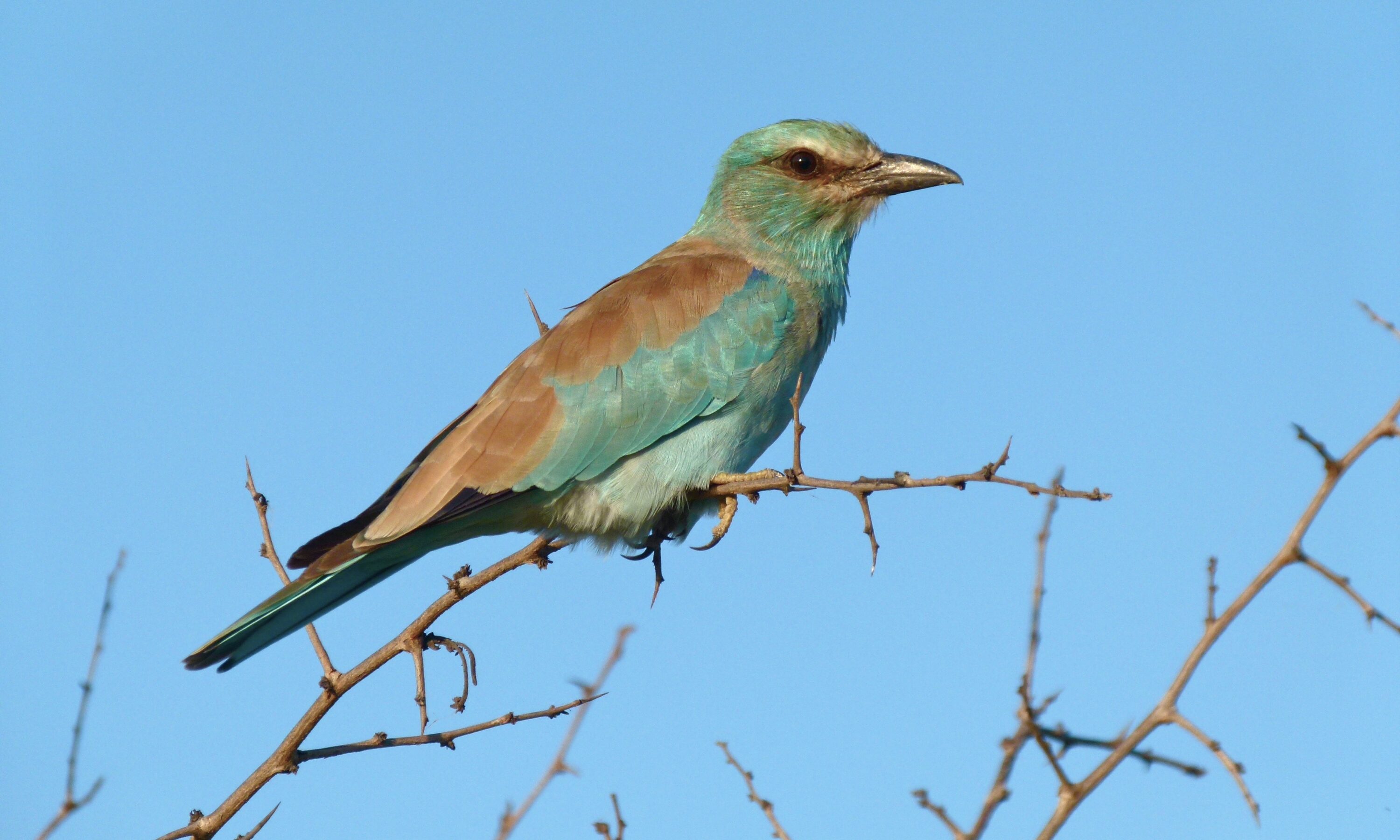
A long-term study of European rollers (Coracias garrulus) in Jaén and adjoining parts of Córdoba, southern Spain, found only 16 breeding pairs in 10 active territories during a comprehensive census in 2024. Published online on 5 June 2026, the study combined monitoring from 2004 to 2025 across 18 municipalities and 55 known breeding territories.
Across the full monitoring record, researchers documented a historical maximum of 65 pairs associated with 55 territories. They describe the contrast with the 2024 census as a severe decline, but also make an important methodological qualification: monitoring effort was not complete or uniform in every year. The historical maximum combines occupations recorded in different years and does not necessarily represent 65 pairs present simultaneously. The authors therefore say the comparison should be read as the known historical range of occupancy versus the robust 2024 snapshot, rather than as an exact demographic decline.
The contraction was also visible geographically. Of 122 surveyed 10 × 10 km grid squares, 20 had held rollers at some point during the monitoring period, whereas only seven remained occupied by at least one pair in the current assessment. The authors interpret the loss of birds from historically occupied squares as local disappearance rather than a shift into newly occupied parts of the study area.
Olive landscapes and old buildings shaped the remaining territories
Most breeding territories lay in agricultural landscapes dominated by olive groves. Olive cultivation surrounded 84.5% of the recorded territories, while cereal fields accounted for 15.5%. The researchers note that territories in cereal-dominated landscapes tended to remain occupied for longer and often had higher productivity, but explicitly state that the study cannot conclusively attribute those differences to land use and that further work is needed.
Nest-site availability was another prominent feature. Cavities in rural buildings accounted for 76.9% of recorded nesting substrates, followed by nest boxes at 15.4%, nesting structures installed for Lesser Kestrels at 4.6% and tree cavities at 3.1%. Several territories ceased to be occupied after the collapse or renovation of farm buildings that had contained nests.
Pesticides and nest-site loss dominated recorded threats
The study also recorded pressures around the known territories. Excessive use of plant-protection products — herbicides, insecticides and fungicides — made up 63.6% of the recorded threat observations. The authors link this particularly to intensive olive-growing areas, where repeated treatments can reduce the large invertebrates on which rollers feed. Loss and deterioration of traditional rural buildings accounted for 21.8% of recorded threats. In 2025, road works along three local roads removed more than 500 trees; the authors report that many had supported stable roller pairs.
Nest boxes had partly compensated for the loss of natural and building cavities in some locations, and intensively monitored nest-box sites retained comparatively stable occupation. In the subset of sites with reproductive monitoring, nest boxes averaged 4.18 chicks per pair and Lesser Kestrel nesting structures 3.75, compared with 3.46 in farm-building cavities; these figures came only from the more intensively monitored sites rather than the full population. The authors nevertheless point out that artificial boxes can overheat if they are poorly placed, making orientation and shade important in the Mediterranean climate.
They recommend protecting traditional buildings with active nest sites, retaining mature roadside and boundary trees, installing and maintaining appropriately positioned nest boxes, limiting insecticide use in breeding territories and continuing standardised population monitoring.
Population & status
Related news
Portugal’s European Roller Breeding Population Grew 26% While Breeding Range Shrank 67%
More than two decades of monitoring found that Portugal’s European roller breeding population increased by about 26% since…
Read story →
European Roller Chicks in Cropland Landscapes Differed in Specific Antioxidant and Immune Markers
In central Italy, cropland-raised European roller chicks had lower expression of nine genes and lower catalase activity, but…
Read story →
European Rollers disappeared as breeding birds from southeastern Poland after 2022
Long-term monitoring in southeastern Poland recorded 43 occupied European roller sites in 2009, but breeding disappeared after 2022…
Read story →SPECIES IN THIS STORY
Species in this story

Independent research and conservation news archive
Did you find this information useful?
Wildlife Vagabond is independently built and maintained. Voluntary support helps cover source verification, hosting and continued work on research and conservation news.
Support Wildlife VagabondThe news archive will remain freely available.