
All 114 Wild Boar Livers Exceeded EU PFAS Limits in a German Dataset

A German assessment of per- and polyfluoroalkyl substances (PFAS) found that all 114 wild boar (Sus scrofa) liver samples exceeded at least the European Union maximum levels for PFOS and the sum of four regulated PFAS. Among 152 meat samples, 19—12.5%—exceeded at least one applicable EU maximum level.
PFAS are a large group of human-made chemicals used in many industrial and consumer products. Many are extremely persistent in the environment and can accumulate in organisms; wild boar are useful bioindicators because their omnivorous diet and position in the food web can expose them to contamination from several sources.
The study evaluated 266 samples from several German federal states, mostly from 2023. Researchers analysed data for PFOS, PFOA, PFNA and PFHxS. The arithmetic mean concentration of the four substances combined was 5.18 µg/kg in meat and 448 µg/kg in liver; median concentrations were 1.24 and 339 µg/kg, respectively.
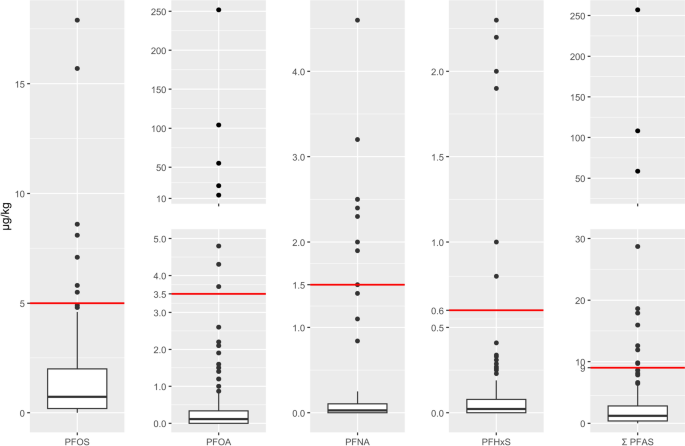
PFOS accumulated most strongly in liver
PFOS dominated most samples and accumulated particularly strongly in liver. The median combined PFAS concentration in liver was roughly 250 times that in meat. Even the least contaminated liver sample exceeded the EU limit for the combined four PFAS, while the most contaminated reached 3,494 µg/kg.
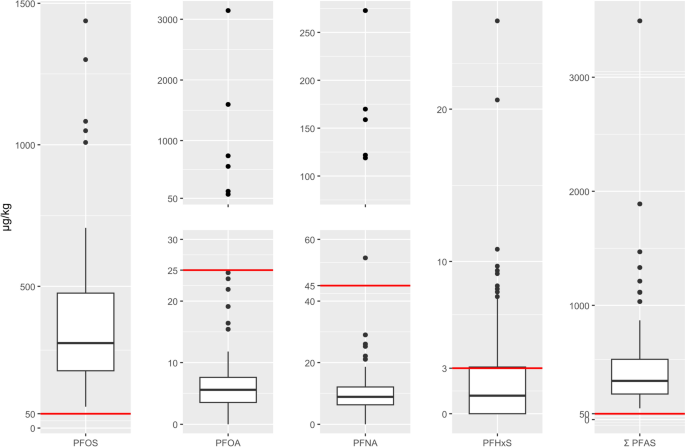
Liver produced the highest dietary exposure estimates
The authors also assessed dietary exposure using the European Food Safety Authority’s tolerable weekly intake. Under their consumption assumptions, average wild-boar-meat consumers exceeded this threshold for 3 of 152 samples, while the modelled threshold was exceeded for 70 of 152 samples among heavy consumers. For liver, the corresponding figures were 106 of 114 for average consumers and all 114 for heavy consumers. The calculations concern long-term dietary exposure rather than an immediate effect from a single meal.
Altötting stood out as a PFAS hotspot
The three meat samples that would have exceeded the tolerable weekly intake for average consumers all came from Altötting in Bavaria, Germany, a known PFAS hotspot linked to historical fluoropolymer production. In that district, PFOA rather than PFOS dominated several samples, unlike the general pattern in the dataset. The study also found that 51 meat samples remained below the EU maximum levels but would still have exceeded the tolerable weekly intake under the heavy-consumption scenario, showing that legal marketability and long-term dietary exposure are not the same measure. The authors caution that exact geographic origin was unavailable for some samples, including some obtained from retail outlets, so not every sample could be assigned securely to a specific German region.
Other research
Related news

Satellite Count Recorded 15.7% Fewer Elephants Than Aircraft in Botswana
A synchronous Botswana survey counted 816 elephants from aircraft but only 688 visible in 30 cm satellite imagery.…
Read story →
Lesser Black-backed Gulls Made Up 73% of Paresis Cases in Lisbon
A ten-year review of gull admissions from Lisbon and Setúbal found that lesser black-backed gulls dominated paresis cases,…
Read story →
Video Collars Showed GPS Methods Were Only About 70% Accurate at Detecting Caribou Calving
Video collars from 160 adult females in the Porcupine and Western Arctic herds showed that two GPS movement…
Read story →SPECIES IN THIS STORY
Species in this story

Independent research and conservation news archive
Did you find this information useful?
Wildlife Vagabond is independently built and maintained. Voluntary support helps cover source verification, hosting and continued work on research and conservation news.
Support Wildlife VagabondThe news archive will remain freely available.