
Female Common Eiders in the High-predation Colony Had Higher Baseline Corticosterone and T3
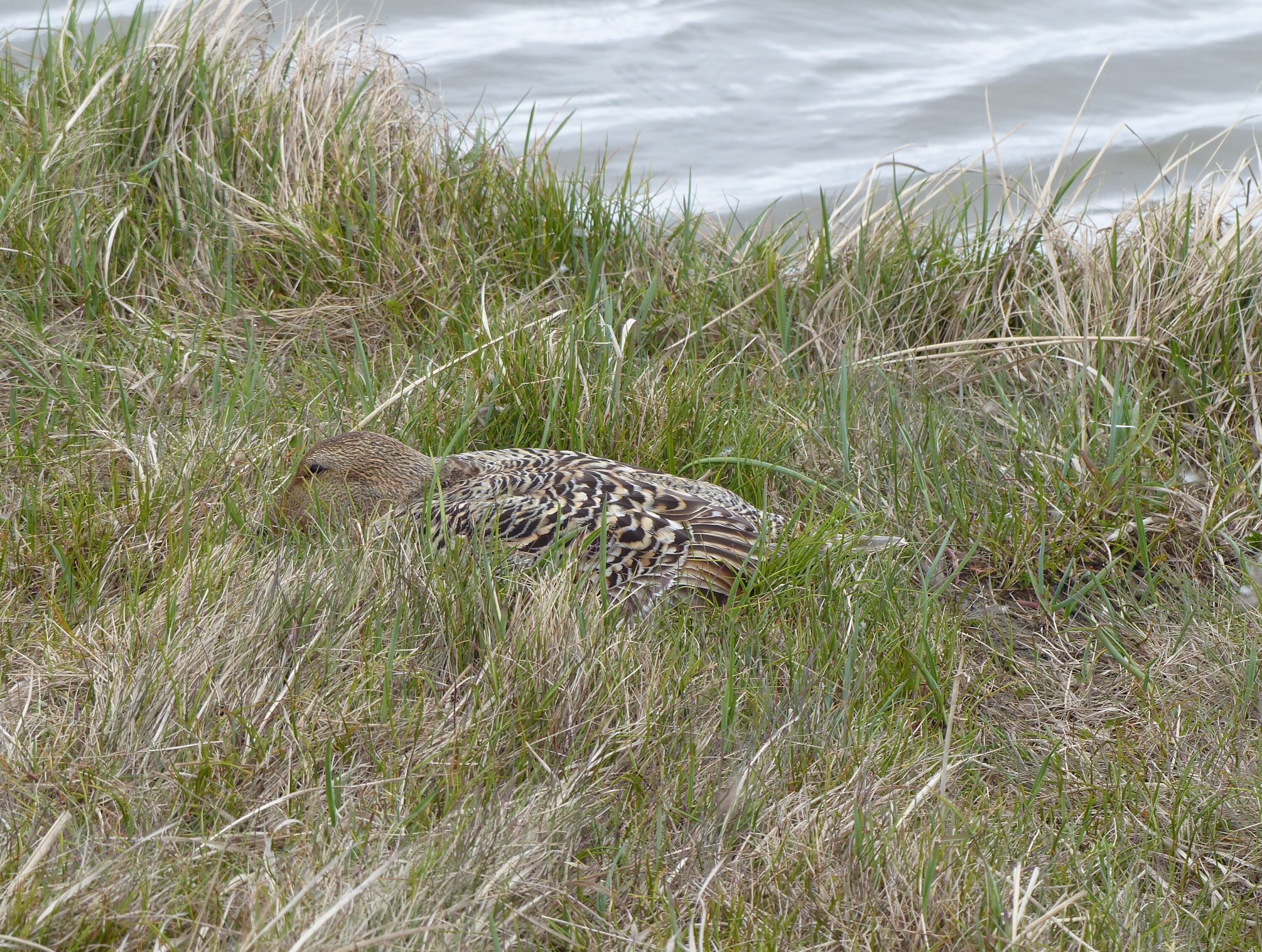
Incubating female common eiders (Somateria mollissima) showed different hormonal profiles at two breeding colonies about 40 km apart in southwestern Finland. At Tvärminne, where human access is restricted and predation pressure from white-tailed eagles is high, females had higher baseline corticosterone and higher T3. At tourist-exposed Bengtskär, where people actively deter predators and eagle activity is much lower, females had higher prolactin.
The study sampled 104 females in 2023: 82 at Tvärminne and 22 at Bengtskär. The researchers used several hormones because no single hormone captures “stress” or reproductive investment on its own.
Three hormonal systems measured different parts of the response
Corticosterone is the main glucocorticoid stress hormone in birds. Its baseline level can help mobilise energy during normal activity, while the rise after capture reflects the acute stress response. T3 and T4 are thyroid hormones involved in metabolic regulation; T3 is the more biologically active form and is often linked to metabolic rate and energy expenditure. Prolactin is closely involved in incubation and parental behaviour.
Baseline and stress-induced corticosterone and baseline prolactin were available for most sampled females. T3 and T4 were measured in only 31 birds — nine from Tvärminne and all 22 from Bengtskär — so conclusions about the thyroid hormones rest on a much smaller and unevenly distributed sample.
Baseline corticosterone and T3 were higher under greater predation pressure
Females at Tvärminne had higher baseline corticosterone and T3 than those at Bengtskär. The authors interpret the higher T3 as consistent with greater metabolic expenditure during incubation under stronger predation pressure. T4 did not differ clearly between colonies.
The higher baseline corticosterone at Tvärminne was opposite to the researchers’ original prediction. They had expected greater reproductive investment at lower-risk Bengtskär to raise baseline corticosterone. Instead, the result suggests that baseline corticosterone may partly reflect the energetic demands of coping with a riskier breeding environment. This is why the authors caution against treating baseline corticosterone as a simple stand-alone measure of parental investment.
Prolactin was higher where eagle pressure was lower
Baseline prolactin was higher at Bengtskär. Because prolactin supports incubation and parental care, this pattern is consistent with greater reproductive investment where perceived predation risk is lower.
The acute corticosterone response after capture, however, did not differ between colonies. Females at the tourist-exposed site therefore retained a physiological response to an immediate stressor despite living where eagle activity was greatly reduced. The study also found no clear relationship between body mass and the hormone levels.
The hormones did not behave as one common “stress signal”
At Tvärminne, T3 and baseline corticosterone increased together, whereas this relationship was absent at Bengtskär. Prolactin, in contrast, showed no clear relationship with the corticosterone measures. A positive relationship between T3 and stress-induced corticosterone at Tvärminne was less robust because it disappeared when the increase from baseline corticosterone was analysed instead.
These differences show why the endocrine systems should not be collapsed into a single stress score: metabolism, acute threat response and parental investment can change independently.
Human presence may act as a predator shield, but the test was observational
The authors describe the results as partly consistent with a human “scarecrow effect”: intensive human presence may deter human-averse predators and lower the risk perceived by breeding eiders. Bengtskär combines heavy tourism and active predator deterrence with low eagle activity, whereas Tvärminne combines little human disturbance with high eagle predation.
The two colonies also differ in habitat structure and nesting density, and the researchers did not experimentally manipulate people or eagles. The study therefore cannot attribute every hormonal difference to the scarecrow effect alone. Longer-term sampling of the same females and experimental work would be needed to distinguish reversible physiological responses from differences in the types of females breeding at each colony.
Physiology
Related news

Colour-Banded Eider Linked Nunavut and Iceland More Than 2,800 Kilometres Apart
A male northern common eider banded on East Bay Island, Nunavut, in 2023 was filmed in western Iceland…
Read story →
Only About Half of American Common Eider Females Were Estimated to Breed in a Given Year
Satellite tracking of 123 females across Maine and eastern Canada estimated overall breeding propensity at 53%, while regional…
Read story →
Higher PFOS Was Linked to Lower Egg Temperatures in Finnish Common Eiders
Researchers studied 18 female common goldeneyes and 37 female common eiders in Finland. Higher PFOS was linked to…
Read story →SPECIES IN THIS STORY
Species in this story

Independent research and conservation news archive
Did you find this information useful?
Wildlife Vagabond is independently built and maintained. Voluntary support helps cover source verification, hosting and continued work on research and conservation news.
Support Wildlife VagabondThe news archive will remain freely available.