
European Rollers Made Seven Apparent Replacement Breeding Attempts After Extreme Rain
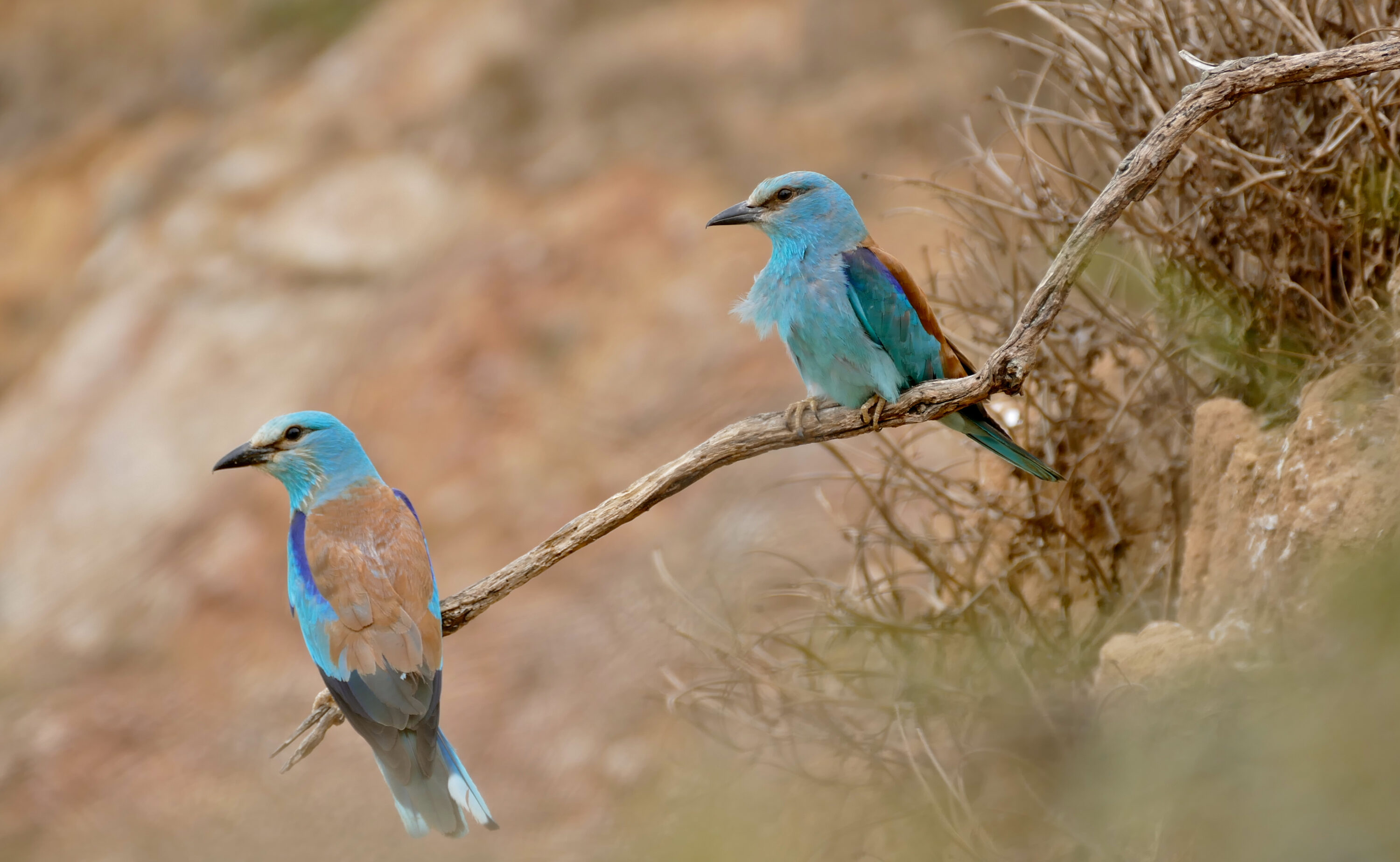
An episode of exceptionally concentrated rainfall in southeastern Spain was followed by an unprecedented increase in second breeding attempts by European rollers (Coracias garrulus) in 2023. A long-term study published in 2026 recorded seven apparent replacement breeding attempts that year, compared with no more than two in any other year of the 2006–2024 monitoring period.
The study followed rollers breeding in the semi-arid Campo de Tabernas in Almería. During the main breeding period, rain is normally scarce, but May 2023 brought 128.2 mm of rain at Tabernas and 191.5 mm in the northeastern part of the study area. Much of it fell within only one or two days around 21–22 May, when many birds were laying or incubating eggs.
Most failures occurred during incubation
Breeding failures were unusually concentrated in the incubation stage. Of the 19 failures for which the timing was known in 2023, 15 — 79% — occurred during incubation. The effect also depended strongly on the type of nest cavity. Stone cavities in human structures were particularly vulnerable, while nest boxes and natural sandstone burrows performed better.
The breeding season changed at both ends. Early-season egg laying began about five days earlier than the long-term average, while the latest quarter of laying dates shifted about 11 days later. Nests remained active well into the second half of July, and one still contained 21-day-old nestlings on 27 July.
Seven replacement attempts followed nest failures
The most unusual response came after nest failures. Rollers normally rear a single brood per year and replacement clutches are rare in this population. Across the full monitoring period, the researchers recorded 20 apparent replacement attempts, normally zero to two per year. Seven occurred in 2023 alone. All seven were successful and together produced 20 fledglings.
The authors deliberately call these apparent replacement attempts. The adult birds were not individually colour-marked, so the researchers could not prove that the new clutch in a failed nest cavity was laid by exactly the same pair. Their definition required a new clutch to appear in the same cavity after a confirmed failure earlier that season, and they consider re-laying by the original pair the most biologically plausible explanation based on the population’s long-term nesting behaviour.
Despite the extreme season, clutch size, fledgling numbers and overall breeding success in 2023 remained similar to the long-term averages. Nest type was important, however. Modelled breeding success was lowest in stone cavities, intermediate in nest boxes and highest in sandstone burrows, although the sandstone estimate had considerable uncertainty because of the smaller sample.
The researchers interpret the surge in replacement attempts as reproductive flexibility that helped buffer the effect of heavy rainfall. They also propose that the same rain that caused the initial failures may temporarily have prolonged the ecological opportunity for late breeding by increasing productivity in the semi-arid landscape and moderating temperatures. This possible benefit does not remove the costs of delay: breeding into the hottest part of summer can expose chicks to heat stress and leave adults and young less time for moulting and preparation for migration. The authors therefore recommend nest-box designs that improve protection from both heavy rain and subsequent heat.
The study was first published in Journal of Avian Biology on 23 January 2026.
Reproduction & development
Related news
Portugal’s European Roller Breeding Population Grew 26% While Breeding Range Shrank 67%
More than two decades of monitoring found that Portugal’s European roller breeding population increased by about 26% since…
Read story →
European Roller Chicks in Cropland Landscapes Differed in Specific Antioxidant and Immune Markers
In central Italy, cropland-raised European roller chicks had lower expression of nine genes and lower catalase activity, but…
Read story →
Complete 2024 Census Found Only 16 European Roller Pairs in the Jaén Study Area
A comprehensive 2024 census found 16 European roller pairs in 10 active territories in Jaén and adjacent Córdoba,…
Read story →SPECIES IN THIS STORY
Species in this story

Independent research and conservation news archive
Did you find this information useful?
Wildlife Vagabond is independently built and maintained. Voluntary support helps cover source verification, hosting and continued work on research and conservation news.
Support Wildlife VagabondThe news archive will remain freely available.