
Eurasian Red Squirrel Genetic Diversity Reflected Forest Landscapes From 40–50 Years Earlier
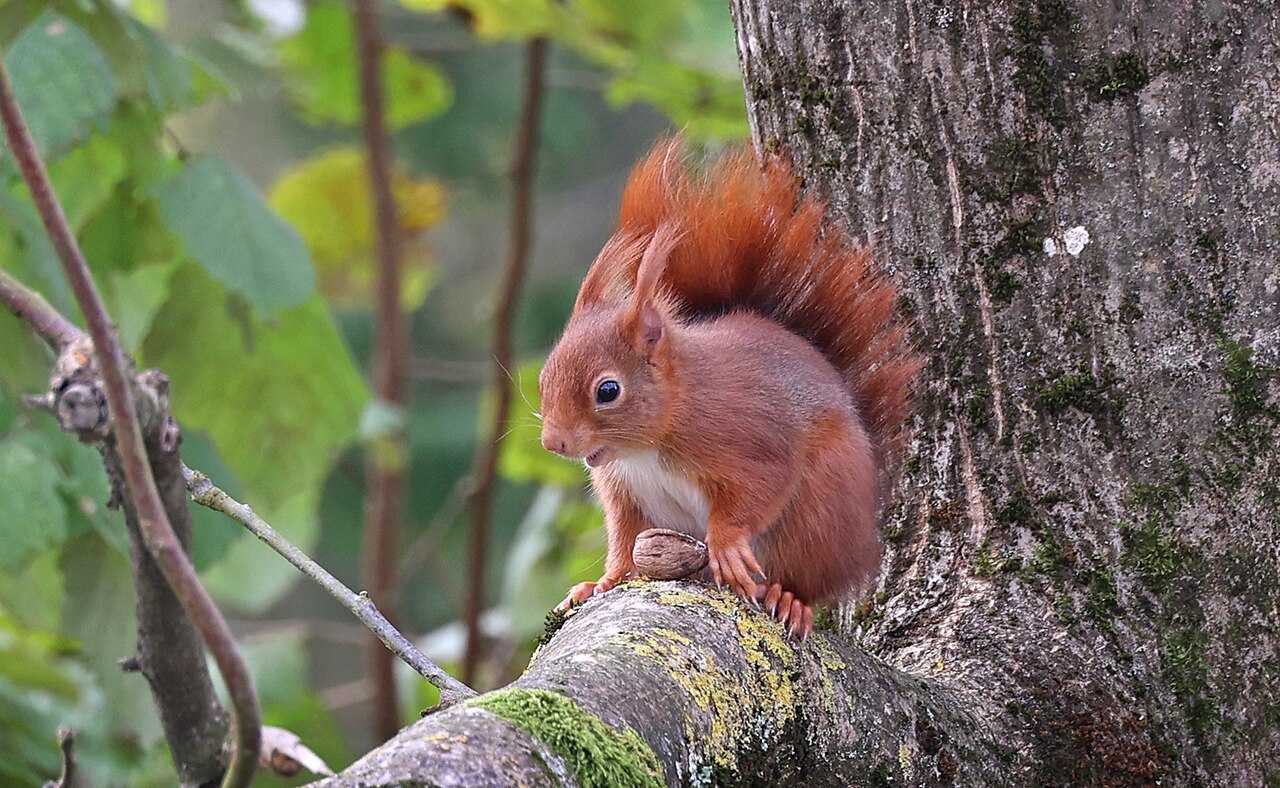
Genetic diversity in Eurasian red squirrels (Sciurus vulgaris) in southern France was most closely related to the amount and arrangement of forest that had existed about 40–50 years before the animals were sampled. The effect also emerged most strongly across broad landscapes, at radii of roughly 12 km or more.
The study used more than 1,100 hair tubes across five 16 × 16 km study areas. These tubes collect hairs when squirrels pass through them, allowing researchers to obtain DNA without having to capture every animal. In total, 443 individual squirrels were genotyped at 16 microsatellite loci.
Two measures described the squirrels’ genetic diversity
The researchers quantified genetic diversity in two ways. Allelic richness describes how many different genetic variants, or alleles, are present after correcting for differences in sample size. Expected heterozygosity describes the probability that two randomly sampled copies of a genetic marker from the population are different. Higher values in either measure therefore indicate a population retaining a broader pool of genetic variation.
Historical forest maps from 1900 to 2019 were then used to calculate both the proportion of land covered by forest and the number of separate forest patches around the sampling locations. The same calculations were repeated across several spatial scales, from 4 to 18 km around each point, and for different historical periods.
The strongest genetic signal came from the forest landscape decades earlier
For both allelic richness and expected heterozygosity, the strongest relationship was with forest conditions around 1980 rather than with the most recent maps. That corresponds to a delay of roughly 40–50 years, or many squirrel generations.
This lag is biologically plausible because genetic diversity does not instantly track habitat change. Population size, dispersal between forest patches, reproduction and genetic drift alter allele frequencies over successive generations. The genetic pattern measured today can therefore still retain the signature of landscapes that existed decades earlier.
Fragmentation showed opposite genetic associations depending on forest amount
The study did not find one universal effect of fragmentation. When relatively little forest remained in the surrounding landscape, genetic diversity tended to be higher where that habitat was concentrated in fewer, larger patches. Splitting a small amount of forest into many patches can create small and isolated local populations, increasing the potential for genetic drift and loss of variation.
When the landscape still contained a relatively large amount of forest, the pattern reversed: genetic diversity tended to be higher where the forest was divided into more patches. The authors discuss several possible reasons for this pattern, including larger local populations, the buffering effect of having several populations, and greater genetic differentiation among patches. The study did not identify which of these processes produced the pattern.
The association between fragmentation and genetic diversity therefore depended on habitat amount. The same number of forest patches can represent very different conditions when those patches contain most of the landscape’s forest versus only a small remnant.
Current maps may not explain today’s genetic pattern
The results show why present-day habitat maps do not necessarily explain present-day genetics. Genetic patterns can respond slowly to landscape change, so present-day diversity may still be more closely associated with habitat structure from several decades earlier.
The study does not show that current forest changes are unimportant. Instead, it suggests that genetic effects of landscape change may take many generations to become detectable. The authors therefore argue that both forest amount and fragmentation should be assessed together, and across historically relevant spatial and temporal scales, when evaluating long-term landscape effects on red squirrels and other forest species.
Genetics & genomics
Related news
Red Squirrels Stayed at Urban and Rural Sites at Similar Rates on Hokkaido
Across nine sites on Hokkaido, red squirrels had nearly identical four-month probabilities of remaining in urban and rural…
Read story →
Squirrelpox in Dollar Became Scotland’s Northernmost Confirmed Case
A red squirrel from Dollar, Clackmannanshire, had squirrelpox confirmed by pathology and qPCR, making it the northernmost reported…
Read story →
Portugal’s Eurasian Red Squirrels Showed Markedly Low Mitochondrial Diversity
The most comprehensive genetic sampling of Eurasian Red Squirrels in Portugal to date found markedly low mitochondrial diversity,…
Read story →SPECIES IN THIS STORY
Species in this story
Independent research and conservation news archive
Did you find this information useful?
Wildlife Vagabond is independently built and maintained. Voluntary support helps cover source verification, hosting and continued work on research and conservation news.
Support Wildlife VagabondThe news archive will remain freely available.