
Willow Tit’s Three Major Genomic Lineages Closely Matched Its Main Song Types

Willow tit (Poecile montanus) song-type boundaries across Europe and Asia closely coincide with three deeply diverged genomic lineages, according to a preprint posted to bioRxiv on 24 April 2026. The study combined a chromosome-level reference genome, whole-genome resequencing and reconstructions of where suitable habitat may have existed during past climatic periods. It was posted as a preprint and had not yet undergone journal peer review, so the conclusions remain provisional.
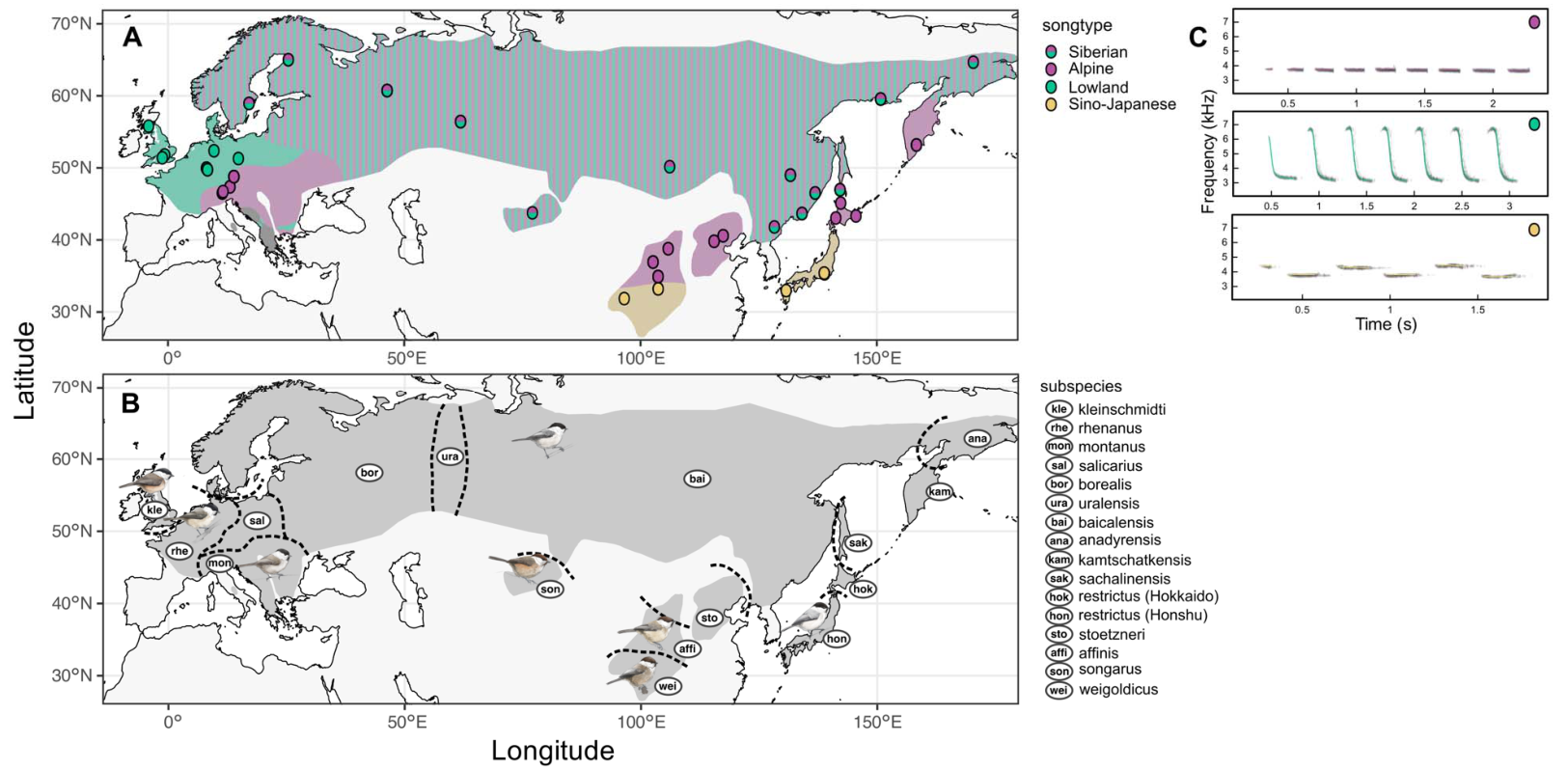
The researchers analysed whole genomes from 88 willow tits representing all 14 recognised subspecies. Their reconstruction indicates an origin in Asia during the Late Pliocene to Early Pleistocene, followed by range expansions that produced three major genomic lineages in Asia, Central Europe and the Northern Palearctic.
Three song types matched the main genomic lineages
The three main song types are known as Lowland, Alpine and Sino-Japanese. Northern populations often combine Alpine and Lowland songs in a mixed “Siberian” repertoire. The researchers assigned song types to genetic samples using their locations and previously mapped song distributions. The boundaries between the three major genomic lineages closely matched these broad song divisions.
Gene flow was stronger between similar song types
Analyses of historical allele sharing—patterns in which populations share alleles in ways that can reveal past genetic exchange—also indicated that gene flow occurred preferentially among lineages with the same or similar song types, even after the researchers accounted for geographic distance. Gene flow means that successful reproduction moves genetic variants between populations. The authors interpret the pattern as consistent with song contributing to prezygotic isolation: behavioural differences may reduce mating between populations before fertilisation can occur.
Glacial isolation left bottleneck signals
Peripheral populations dominated by one song type showed genomic signatures of repeated population bottlenecks associated with past glacial isolation. A population bottleneck is a period when a population becomes much smaller, causing it to lose genetic variation. In contrast, large northern populations retained broader song repertoires and stronger signs that populations had remained genetically connected over long periods.
The authors suggest that culturally transmitted song may have helped maintain lineage boundaries over evolutionary time. Cultural transmission here means that song patterns can be passed socially between birds through learning. They also note that the extent to which willow tit song is actually learned remains incompletely understood: earlier experiments with hand-raised birds suggested that Alpine song might be largely innate, although those experiments were not standardised.
Genetics & genomics
Related news

Natural England Funded Development of a National Willow Tit Recovery Strategy
Natural England funded a 2026–2029 project to build a national recovery strategy for willow tit across several English…
Read story →
Mean Eurasian Blue Tit Winter Count Rose Fourfold in Finnish Urban Survey Plots
Across 31 Finnish settlements, mean Eurasian blue tit counts rose from 2.8 birds per standardised urban plot in…
Read story →
Wet Willow Wildlife Improved 51 Hectares of Wet Woodland and Connected 632 Hectares
The two-year Wet Willow Wildlife project in northwest England improved 51 hectares of wet woodland, increased connectivity across…
Read story →SPECIES IN THIS STORY
Species in this story

Independent research and conservation news archive
Did you find this information useful?
Wildlife Vagabond is independently built and maintained. Voluntary support helps cover source verification, hosting and continued work on research and conservation news.
Support Wildlife VagabondThe news archive will remain freely available.